
Inkhaven Day 30

Note: At 11:59 PM on November 30th 2025, I was eating a banana in the basement of Aumann Hall (as you do), when I slipped on a banana peel (unrelated) and smashed head first into the Lighthaven Blogtech Mainframe (sponsored by Wordpress dot com). This somehow prevented all 41 residents from meeting the submission window, causing all of us to the fail out of Inkhaven right before the finish line. Luckily, everyone submitted their pieces at exactly 11:59 PM, so the data is recoverable! Ben Pace has been keeping me chained up in the basement and wearing a four-foot long dunce cap. He promised to release me on the condition that I successfully recover every single lost blog post. Here are the results of my labors. I am dumping all the recovered material straight into this file. I will split, sort, and archive it tomorrow. You guys write a lot of shit and I don’t feel like reading any of it.
A.G.G. Liu
I’ve previously got real judgmental about 4D shapes, and 2D/3D shapes. Today, let’s get judgmental about fractals!
You love fractals, I love fractals, everybody loves fractals. They are fun to look at, they are fun to program, and they motivate you to learn weird things about measure theory. Sometimes, though, fractals can get a bit samey (which is the point of them). So here’s my list of fractals that are fine, lame, awesome, underrated, and overrated.
Fine: Koch Snowflake

This is everyone’s first fractal. It’s cool! It teaches you that things can have finite area but infinite perimeter. Drawing Koch snowflakes is a good thing to do when learning a new programming language, or when learning L-Systems and other fun recursive stuff like that.
There are fun variations of the Koch snowflake, like the Koch anti-snowflake:

But at the end of the day, Koch snowflakes are a bit vanilla. So I’m going to say that they are just fine.
Lame: Dragon Curves

Don’t get mad at me! I know people love dragon curves. I think it is neat that they can tile the plane.

The best thing about dragon curves is that a bunch of people have written super fun and goofy papers about them, like this and this. But at the end of the day I feel like I Just Don’t Get It. I think dragon curves have a number of nice properties, but the whole picture doesn’t add up to anything very memorable for me.
Awesome: Apollonian Gasket
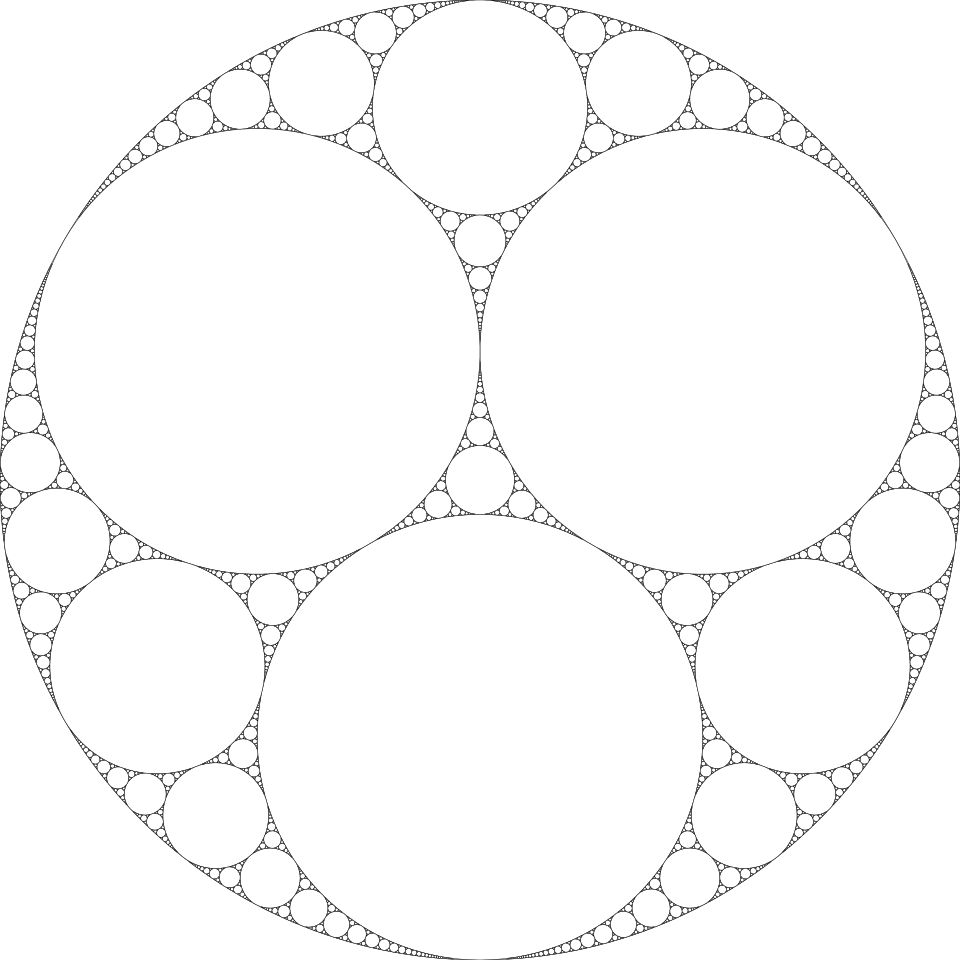
Apollonian gaskets are incredible. They are constructed in an interesting way: you start with any three circles, each tangent to the other two, and then you keep on adding circles that are tangent to three existing circles.
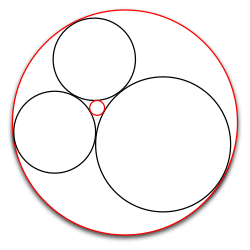
Now what’s awesome about Apollonian gaskets is that they can have weird and wonderful number theoretic properties. The curvature of a circle is 1/r. If any four mutually tangent circles in an Apollonian gasket all have integer curvature then all circles in the gasket will have integer curvature. An example:
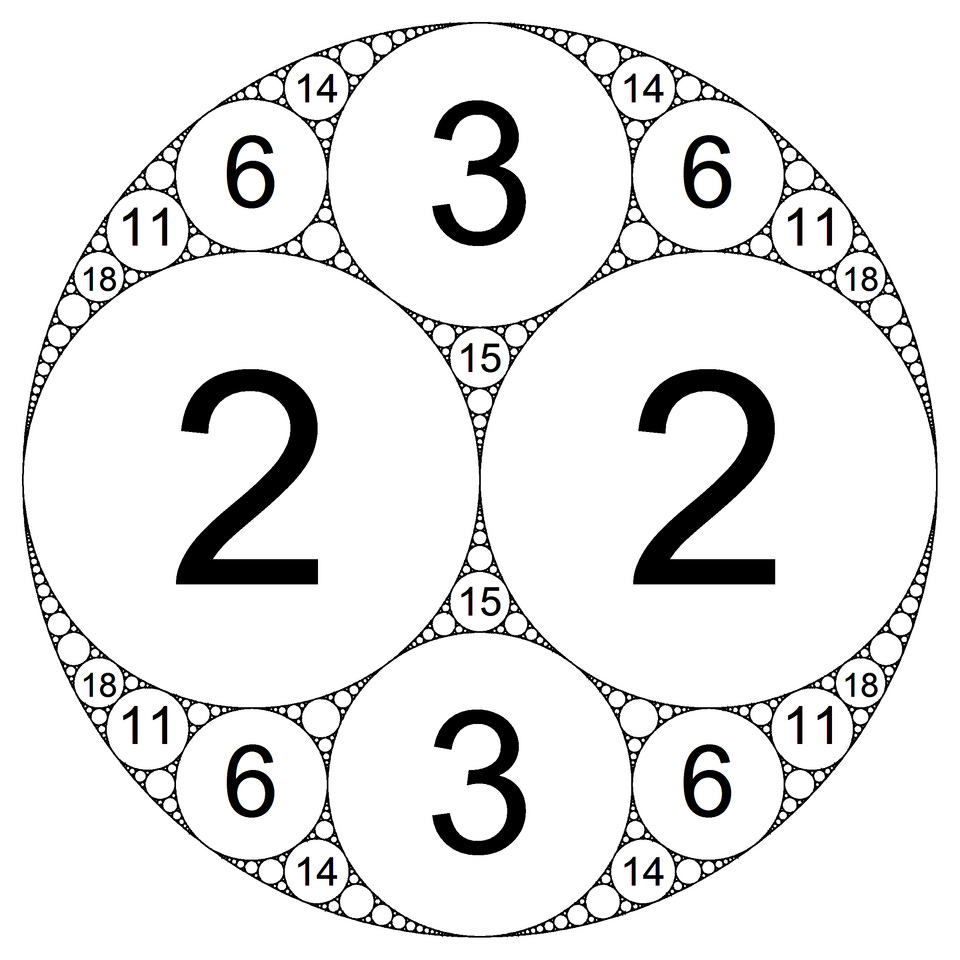
Which integers can appear as curvatures in an Apollonian gasket? Recently this was answered: “almost all” of them are admissible. The best fractals have number theory in them, and the gasket is a case-in-point.
Overrated: The Burning Ship Fractal

Okay so, really cool fractal. It does indeed look like a burning ship. People love it because of this.
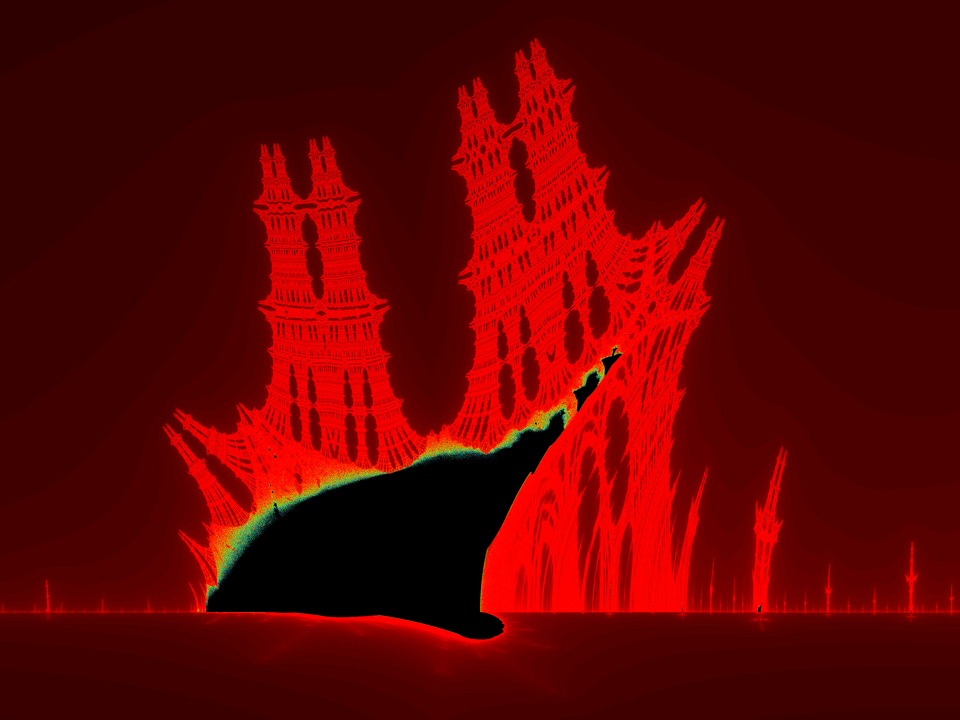
This one really looks like a burning ship. I am unconvinced that there is more to this fractal than the fact that it looks like a burning ship.
Underrated: Rauzy Fractals

Doesn’t look like anything special, right? Rauzy fractals are a way to study “tribonacci substitution”. A tribonacci word is one that is constructed via the following substitution map: s(1) = 12, s(2) = 13, s(3) = 1.
So the sequence evolves like this:
t_{0} = 1
t_{1} = 12
t_{2} = 1213
t_{3} = 1213121
t_{4} = 1213121121312
And so on. You can see from the above that in general the word t_{n} = t_{n-1}t_{n-2}t_{n-3}, resembling the Fibonacci numbers. Hence, “tribonacci”.
To construct the fractal, we iterate down the tribonacci word and interpret the three letters as unit vectors in a three dimensional space which we are summing together. So the first few points are:
1: (1, 0, 0)
2: (1, 1, 0)
1: (2, 1, 0)
3: (2, 1, 1)
1: (3, 1, 1)
Once we have this sequence of points in 3D space, we project them down to the plane like this:
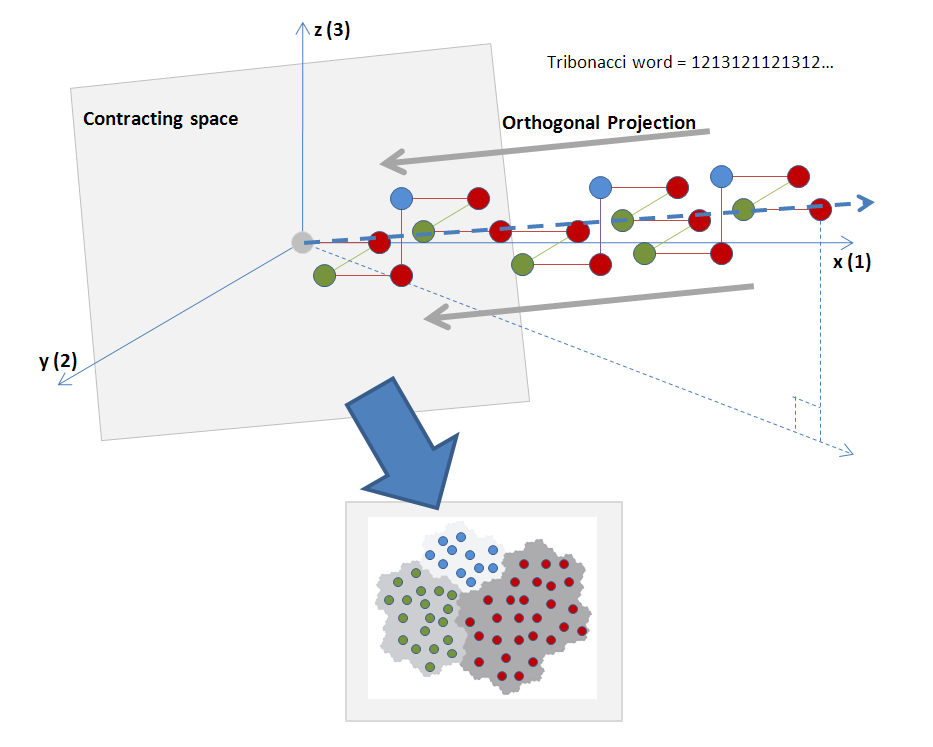
Rauzy fractals tile the plane, so they are like dragon curves but cooler. Numberphile has a nice video on Rauzy fractals if you want to know more.
Adrià Garriga Alonso
To celebrate the final day of Inkhaven, I am creating the definitive list of SLOP and ANTI-SLOP. For those unfamiliar with this beautiful word, slop designates concepts that have some internal validity but are ultimately unhelpful, misleading, or non-insightful. Many PhD-holders spent all of their time in grad school researching complete slop (I am one of these unfortunate fools). Anti-slop designates everything that is useful and wonderful and right with the world.
SLOP
Measure Theory - If you cannot prove things using a fine-grain finite partition of the sample space, you are probably doing mathemagical LARPing that is taking you far away from reality.
Bayesian Machine Learning - It doesn’t work. Unfortunately, only useful for nerd-sniping.
Learning Mandarin - Obviously not slop in general, but definitely slop for me.
Nonparametric Statistics - Too expensive, doesn’t scale. SLOP.
Washington D.C. - Get me out of here!!!
ML Paper Structure - Every paper has the same structure. This really doesn’t work well for mechanistic interpretability, and it’s holding the field back.
Instrumental Convergence - I think the discourse built ontop of this concept has started to markedly diverge from empirical reality, and is potentially veering off into unfalsifiability.
The Classic AI Doom Case - It was supposed to be the case that as soon as AI got near human-level, it was going to FOOM. It’s going to take 5-20 years for this to happen. AIs aren’t hyper consequentialist optimizers either. It seems like they also care about deontological and virtue ethical constraints on their behavior.
ANTI-SLOP
Frequentism - It just works bro.
Sparse Autoencoders - Many are saying that SAEs are joever, but I think there are real reasons to hope that progress can be made.
Aqua from Konosuba - Vewy cute, I like.
Richard Hanania - Highly generative blogger. Also, an insane person.
The Royal Society - They caused the Industrial Revolution. Repeat after me: “Thank you, The Royal Society!”
Spain - The economy is growing. Immigration is helping. There’s hope. Viva España, frfr!
Fil-C - Glorious, majestic, memory-safe C. Forget Rust, Fil-C is safer.
Statistical bootstrapping - Me no like thinky. Bootstrap work gud.
AMD - Their FLOPS/$ is unbeatable.
Computer Science - It actually is a science!
S-risk Reduction - We have to reduce animal suffering. Factory farming is a blight on humanity.
Kaguya-sama: Love Is War - The GOAT of anime. Just one of the cutest shows ever.
Bidirectional Search - We’ve seen this algorithm crop up in a couple neural networks already, and should expect to keep on seeing it when investigating model internals.
LessWrong - I love you, even when you strong downvote me into oblivion.
Ben Goldhaber
To celebrate the release of Gemini 3, I’m doing my favorite evening activity: researching Chinese Four Character Idioms.
I love wisdom. Can’t get enough of the stuff. Sometimes though I read something wise in English and think, “gee, I wish this wisdom was four words.” Rarely do I have this problem in Mandarin. This makes Mandarin the greatest language in world (sorry Chemehuevi-stans, the rest of us are over it).

I’ve previously discussed my favorite Chinese Four Character Idioms here. In the interest of fairness, I will now discuss my most hated Chinese Four Character Idioms.
易如反掌 (yì rú fǎn zhǎng) As easy as turning over one’s hand.
This is what you say when something is as easy as turning over one’s hand.
I like my idioms to contain an interesting story or image somewhere in there. Something unconventional that pulls me into its little, idiomatic pocket universe.
This has none of that, and I hate it. It’s less of an “idiom” and more of a “true thing you can say with four words”.
I’ve asked Gemini 3 to rate this idiom from the point of view of a hard-boiled man from a Dashiell Hammett novel:
The rain was beating against the office window like a drummer with no sense of rhythm. I poured out two fingers of cheap rye. I pushed it forward to the exotic dame across my desk.
She was trying to tell me how easy the job was going to be.
She used a phrase. Yì rú fǎn zhǎng.
“Easy as turning over your hand,” she said.
I looked at my hand. It was scarred, stained with tobacco, and currently shaking from a lack of sleep and too much bad coffee. I turned it over. Palm up. Palm down.
“Let me give it to you straight, sweetheart: this idiom is lousy. It’s a flimflam. In this town, words are supposed to have weight. You got idioms about tigers, snakes, and guys smashing bells while plugging their own ears. That’s drama. That’s a narrative arc. But yì rú fǎn zhǎng? That’s not an idiom. That’s just a description.”
I tried it again. I flipped my hand over on the desk. Smack. Smack. The only thing it accomplished was scaring the cockroaches.
And it wasn’t gonna get me one step closer to solving this murder.
I couldn’t have said it better myself.

對牛彈琴 (duì niú tán qín) Playing the guqin to a cow
Similar to “casting pearls before swine”. The guqin is a beautiful stringed instrument. Apparently, only a naïve fool would play the guqin to a cow.
However, playing music to animals is one of the greatest things a human can do. Here’s a video of Glenn Gould singing Mahler to a herd of elephants. Watch the video closely (as I do on a weekly basis). Is the singing wasted on the elephants? No. They clearly appreciate it! Do you want to live in a world were people don’t sing at our fellow animals?
My heart sinks thinking about all the Chinese cows who’ve been deprived of aural bliss due to this thoughtless piece of “wisdom”. This is wisdom for the Ebenezer Scrooges of the world.
I’ve asked Gemini 3 to rate this idiom from the point of view of an ork from 40k:
OI! LISSEN UP YA GITS!
I herd dis humie sayin’. “Play da Loot to da Cow.”
WOT?!
DIS IS WHY HUMANS LOSE!
Okay, that’s not where I was coming from, but fair enough Gemini 3, fair enough.

A Cool Frog
The rule of threes tells me to find another Chinese Four Character Idiom that I hate. However, I actually like all the rest. There are only two bad ones.
So here’s a nice image of a frog instead.

Claire Wang
I am writing this blog post from Aitutaki in the Cook Islands. Well, not “writing” exactly. More precisely, I’m currently etching these words manually onto a sheet of tapa. When I’m finished, my assistant will fold my work up, stick it in a glass bottle, and set it adrift on the Southern Pacific Ocean. I haven’t even seen a computer in eight years.
If you’re reading this, you’ve found my little bottle. Lucky you. Or rather, good job! You were outside taking a walk, touching grass, and somehow you’ve discovered my bizarre letter. What an adventure. Much better than staring at your fucking phone inside all day, right?? Right.
I glad we get to have this connection, even if it only goes one way. Maybe when you go home, you will write a letter back telling me whatever it is that you’ve been needing to say to someone. Stick it in a bottle labeled “Claire Wang, Ootu Beach, Aitutaki, COOK ISLANDS” and toss it into the ocean. Obviously, it won’t come back to me. But maybe it will?
I spent three days preparing the tapa for this post. I stripped a paper mulberry tree, soaked the bark overnight, beat it with a hammer for seven hours, weaved the sheets together, and then set the whole thing out to dry. A real taunga can do this all in a day and a half — maybe less. There’s so much to learn. Three hours into the hammering I started sobbing, but I was happy. Now I’m writing all this out, and what’s coming out of me is stream-of-consciousness bullshit. “Not worth the paper it’s written on”, but actually. You don’t have to keep this. You can burn it if you want (I’m serious). This letter is yours. I don’t get a say in what you do with it now.
In a better world we’d just be talking in-person, having a real conversation. But we are beset (last I checked) by a literal 1.5 trillion dollar industry built entirely around stealing our attention and breaking our brains. I don’t need to check the news on a screen to know that this has all gotten so much worse since I tuned it all out. Since that Berkeley morning almost a decade ago when I went out for a walk and just didn’t have it in me to turn back.
I told you fuckers to read Digital Minimalism, but you just wouldn’t listen!
If you’re reading this, years must have passed since I wrote this. I wonder who it is I now am. I’d like to think I now know how to make tapa in under a day and half, and that I am teaching others how to do the same, and that they are weaving into the cloth things they know are worth sharing, and that they’re giving it all freely away.
Harri Besceli
Naughty, naughty Harri Best Jelly. Put your thinking caps on, children, and listen closely. I’m going to show you the Hairy Jelly Donut Theorem, which proves to a mathematical degree of certainty that you won’t have time to comb your hair if you really care about optimizing your habits for maximum impact. If you aren’t bright enough to follow the proof, don’t despair, you can still work in operations.
When I eat a lot of ice cream, I am scoop insensitive. Yummy!
You may call me Prince Hal. What’s this? A box of treasure from CEA? Well hurry up and open it — what’s inside? Tennis balls? My friends, they’ve sent me four tennis balls. Four balls with the inscriptions: “scope sensitivity”, “scout mindset”, “impartiality”, and “recognition of tradeoffs”. Harrumph! This jest will savour but of shallow wit, when thousands weep more than did laugh at it.
[Farts solemnly]
I have christened the expanding pile of trash next to bed. His name is PlayPumps, and no matter how much I scold him he just won’t go away. There is also an expanding pile of pure utility next to my bed, but naughty PlayPumps keeps getting in the way and gobbling him up. If only there was some way to figure this all out. I shall don my thinking cap and ratiocinate upon this subject. Murphyjitsu, engaged! Yes. I feel it. I feel the insight getting ready to spring forth from my supple brain lobules. Ah. Ah!!! Nevermind, I can’t think of anything. Pass the hummus please.
Forget all that Prince Hal stuff, I was being cheeky. My real name is Don Enriquixote, the man from La Mancha, California, and I esteem above all else books of chivalry such as “Doing Good Better” and “The Precipice”. They have revealed to me my true calling as knight-less-errant, sent to this world to sally forth into the very heart of peril, and to reap eternal renown and fame! No really — please pass the hummus my tummy is growling.
What’s this? Inkhaven Spotlight? Hinteresting… most hinteresting. Huh? What?? I’m not on it? My beautiful posts. Omitted from the “spotlight”, banished to the eternal dark? This is absurd, vile — an insult to humanity itself! This calls for swift redress. Here, take the tub o’ hummus back for a moment. I need all ten of my greedy little fingers to be unleashed upon mine keyboard. Insolent whelps! You’ll rue this day. My cutting observations and post-ironic wit will cut you all down. You should have finished me when you had the chance. Me, the boy who lived. Harri Potterceli.
Boy, I’m sleepy.
Hauke Hillebrandt
The desire to have children is a powerful drive in humans, so naively one would expect that the demand for having children is highly inelastic. In reality, fertility choices are highly sensitive on the margin, and poorly chosen regulations which drive up the cost of child-rearing have had disastrous effects on reproduction.
Poor child safety laws negatively affect fertility.
In the U.S., car-safety requirements have imposed a discontinuous jump in the cost of having a third child. Child car seat laws force parents to either not have a third child or to purchase larger cars. This resulted in 8,000 fewer births in 2017, and 145,000 fewer births overall since 1980. Meanwhile, these laws prevented fewer than 60 fatalities in 2017, meaning for every life saved 133 births never happened. (1)
Having fewer childcare regulations is correlated with having a smaller fertility gap. (6)
“Child-staff ratio” mandates for childcare providers are excessively stringent. Increasing such limits by as little as one child can reduce the cost of child care by 9-20%. (7)
Poor housing policy (zoning, height limits, parking minimums, slow permitting) negatively affects fertility.
If U.S. rents had stayed flat since 1990, there would have been 11% more children born into the 2010s. Around 13 million births did not happen between 1990 and 2020 due to rising housing costs. Particularly important is that 3+ bedroom units are cheap. Housing reform tends to focus on increasing the supply of studios and one-bedroom units, which has limited direct impact on fertility. (2)
Land use regulation strongly reduces fertility rates for teens and women in their 20s by a lot, while raising the fertility of women in their 30s and up by a little bit, resulting in a large net loss in fertility overall across all studied geographies. (3)
Environmental contaminants negatively affect fertility.
In China, air pollution damages biological fertility and also changed women’s reproductive preferences (due to the need to invest more to offset health risks in their children). (4)
Airborne lead exposure in the U.S. between 1978 and 1988 dropped fertility by an average of 0.14 children per woman (a 6.4% drop mean fertility). (5)
Burdensome social norms negatively affect fertility.
Surveys of UK parents shows that they will not allow their children to play outside until age 11, even though they themselves were allowed to play at age 9. (8)
US areas that legally permit “free range kids” have multiple enforcement norms that make allowing your kids to play alone outside effectively impossible. (9)
This accumulated evidence suggests an overall picture that special attention (and not merely good intentions) needs to be brought to bear on reducing the cost of child rearing. Poor regulation and expensive social norms are very much at fault here. (10)
Shoag & Russell, Land Use Regulations and Fertility Rates, 2017
Gao, Song & Timmins, The Fertility Consequences of Air Pollution in China, 2022
Clay, Portnykh, & Severnini, Toxic Truth: Lead and Fertility, 2019
Flowers, Geloso, Piano, & Stone, Childcare Regulation and the Fertility Gap, 2024
Sally Weale, “UK Children Not Allowed to Play Outside until Two Years Older than Parents’ Generation,” The Guardian, 2021
Astral Codex Ten, Book Review: Selfish Reasons to Have More Kids, 2025
Human Invariant
Artists, athletes, and models have career agents who receive a percentage of their client’s earnings in exchange for advancing their client’s interests. Why doesn’t every profession use this model?
Robin Hanson has a proposal for us: career agents for everyone. Currently, the federal government is everyone’s agent, in that it takes a chunk of your earnings and is incentivized to help you earn more (which they do very poorly). Hanson says the government should instead individually auction off tax collection rights. So, an interested party can buy the right to collect my taxes. They are now incentivized to advance my career.
Everybody wins:
The government gets at least as much as it expected to gain were it to retain the tax collection right (modulo the time value of money).
The private agency bidding on the rights would only do so if it believed they are in a position to create value.
The individual whose rights were sold now has their career supervised with more care.
If a poorly performing agency sits on someone’s tax rights, a sale to an interested buyer can be forced via a Harberger tax.
This is Hanson’s proposal. I am skeptical.
It is unclear to me though how much value this will unlock. Currently, career agents work in markets with heavy-tail payoffs (i.e. where most people earn very little and few earn a lot). Film, sports, music, and so on, are all high variance industries. So, one or two big winners can compensate for hundreds of duds. Medicine, code-monkeying, and the law see a much tighter spread in wage. Consequently, the agency model doesn’t work in those industries generally. The high-variance sectors of these professions do have agents (VCs are essentially agents).
So, if Hanson’s career agent markets were legalized, how much trading volume would there actually be? Most careers have low-variance payoffs, so I suspect the career agent market will be illiquid.
Regardless, Hanson’s model does provide a meta-lesson about how to manage your own career: if you plan on pursuing a high variance career, it is important to actively seek out “career agent”-like people to invest in you (e.g. mentors).
Jenn
foucault was a rationalist. there, i said it.
so in some sense this is an annoying, nerdy point that no one wants to hear. but i think foucault says a lot of things that map nicely onto rationalist concepts (and can help improve them), and that foucault-likers would benefit from reading rationalists seriously and should stop being such snobs about us.
so in some ways foucault and rationalism seem totally incompatible. the stereotype of foucault is that he:
doesn’t think anything is true
thinks everything is socially constructed
was some sort of armchair revolutionary
is a wordcel
and the stereotype of rationalists is that they:
believe in objective truth
think that science and math are objective, and that nothing else is
are techbros that love the status-quo
are shape-rotators
but careful reading reveals that both of them:
believe in some ground truths, but put emphasis on the map vs. territory distinction
think that bad incentives and bad concepts can impart potentially unbounded amounts of change to our knowledge producing systems
are anti-authoritarian, and care a lot about making it possible that humans will one day enjoy very good lives very different from the status quo
really care about how systems work, so are both word-cels and shape-rotators at the same time
so for instance on the subject of truth, in “the useful idea of truth” yud wrote:
And so saying ‘I believe the sky is blue, and that’s true!’ typically conveys the same information as ‘I believe the sky is blue’ or just saying ‘The sky is blue’ - namely, that your mental model of the world contains a blue sky.
Meditation:
If the above is true, aren’t the postmodernists right? Isn’t all this talk of ‘truth’ just an attempt to assert the privilege of your own beliefs over others, when there’s nothing that can actually compare a belief to reality itself, outside of anyone’s head?
…
The reply I gave to Dale Carrico - who declaimed to me that he knew what it meant for a belief to be falsifiable, but not what it meant for beliefs to be true - was that my beliefs determine my experimental predictions, but only reality gets to determine my experimental results. If I believe very strongly that I can fly, then this belief may lead me to step off a cliff, expecting to be safe; but only the truth of this belief can possibly save me from plummeting to the ground and ending my experiences with a splat.
which is a way of expressing tarski’s ‘deflationary theory of truth’, which says that you can just remove ‘is true’ from most sentences and you’ll be fine. ‘is true’ doesnt pay rent, the thing actually doing the work for you is the underlying mental model.
with foucault, you start from the opposite direction rhetorically but end up in the same place. foucault gives his theory of science in The Order of Things, where he talks about his concept of epistemes, which are knowledge regimes that shape what concepts are thinkable, what counts as an explanation, what kinds of entities can exist, and what forms of reasoning count as valid. One could say that foucault is talking about deep priors, frames, and the fact that people dont generally own their own epistemic operating system. hm!!
when foucault does his “archaeology” of knowledge, he’s just talking about the causal inputs that make epistemes turn out one way rather than another. gee, that sure sounds similar to rationalists concepts like ‘understanding how exogenous incentives shape your beliefs’.
finally, once you read about power-knowledge and then you read meditations on moloch, youll never stop seeing the connections between the two.
so, at this point you might say to me ‘okay jenn but im still not going to read your dumb french philosopher.’ to which i say first: wow, rude!!! and then i say, just check this out from discipline & punish where foucault talks about the panoptic nature of the state:
Hence the major effect of the Panopticon: to induce in the inmate a state of conscious and permanent visibility that assures the automatic functioning of power. So to arrange things that the surveillance is permanent in its effects, even if it is discontinuous in its action; that the perfection of power should tend to render its actual exercise unnecessary; that this architectural apparatus should be a machine for creating and sustaining a power relation independent of the person who exercises it; in short, that the inmates should be caught up in a power situation of which they are themselves the bearers. To achieve this, it is at once too much and too little that the prisoner should be constantly observed by an inspector: too little, for what matters is that he knows himself to be observed; too much, because he has no need in fact of being so. In view of this, Bentham laid down the principle that power should be visible and unverifiable. Visible: the inmate will constantly have before his eyes the tall outline of the central tower from which he is spied upon. Unverifiable: the inmate must never know whether he is being looked at at any one moment; but he must be sure that he may always be so. In order to make the presence or absence of the inspector unverifiable, so that the prisoners, in their cells, cannot even see a shadow, Bentham envisaged not only venetian blinds on the windows of the central observation hall, but, on the inside, partitions that intersected the hall at right angles and, in order to pass from one quarter to the other, not doors but zig-zag openings; for the slightest noise, a gleam of light, a brightness in a half-opened door would betray the presence of the guardian. The Panopticon is a machine for dissociating the see/being seen dyad: in the peripheric ring, one is totally seen, without ever seeing; in the central tower, one sees everything without ever being seen.
It is an important mechanism, for it automatizes and disindividualizes power. Power has its principle not so much in a person as in a certain concerted distribution of bodies, surfaces, lights, gazes; in an arrangement whose internal mechanisms produce the relation in which individuals are caught up. The ceremonies, the rituals, the marks by which the sovereign’s surplus power was manifested are useless. There is a machinery that assures dissymmetry, disequilibrium, difference. Consequently, it does not matter who exercises power. Any individual, taken almost at random, can operate the machine: in the absence of the director, his family, his friends, his visitors, even his servants. Similarly, it does not matter what motive animates him: the curiosity of the indiscreet, the malice of a child, the thirst for knowledge of a philosopher who wishes to visit this museum of human nature, or the perversity of those who take pleasure in spying and punishing. The more numerous those anonymous and temporary observers are, the greater the risk for the inmate of being surprised and the greater his anxious awareness of being observed. The Panopticon is a marvellous machine which, whatever use one may wish to put it to, produces homogeneous effects of power.
can we all just stop hating on the french for five minutes and admit to ourselves that this goes unreasonably hard? this is actually a good frame for thinking about what the state does. maybe it takes reading seeing like a state to finally realize this retroactively, but yes foucault did have substance! rant over
Lydia Nottingham
Today I investigate Sample Space Reducing (SSR) processes. This and this are relevant papers.
Contents:
What are SSRs?
Simulating SSRs
SSRs and Machine Learning
What are SSRs?
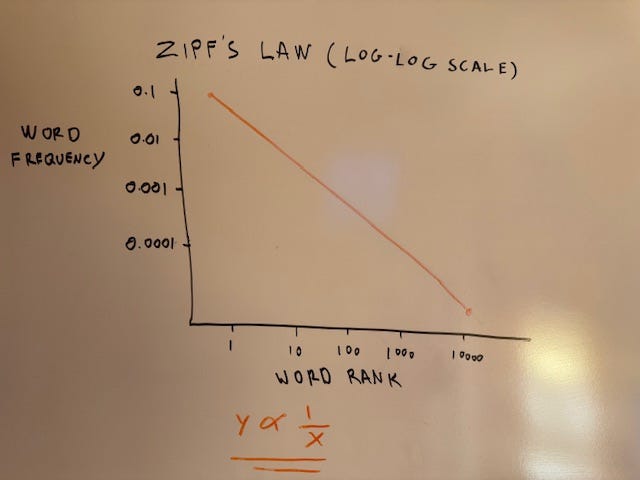
Sample space reduction is a mechanism that explains why power laws / scale-free distributions emerge. Scale-free distributions are really common. For example there is Zipf’s law, which is an empirical law that relates the frequency and the frequency rank of words in natural language:
Why are scale-free distributions so common? Typical answers include:
Multiplicative growth
But these explanations are neither necessary nor sufficient. We can ground this question in SSRs because they:
Are common
Produce scale-free distributions
An SSR is a process that chops the sample space down over time.
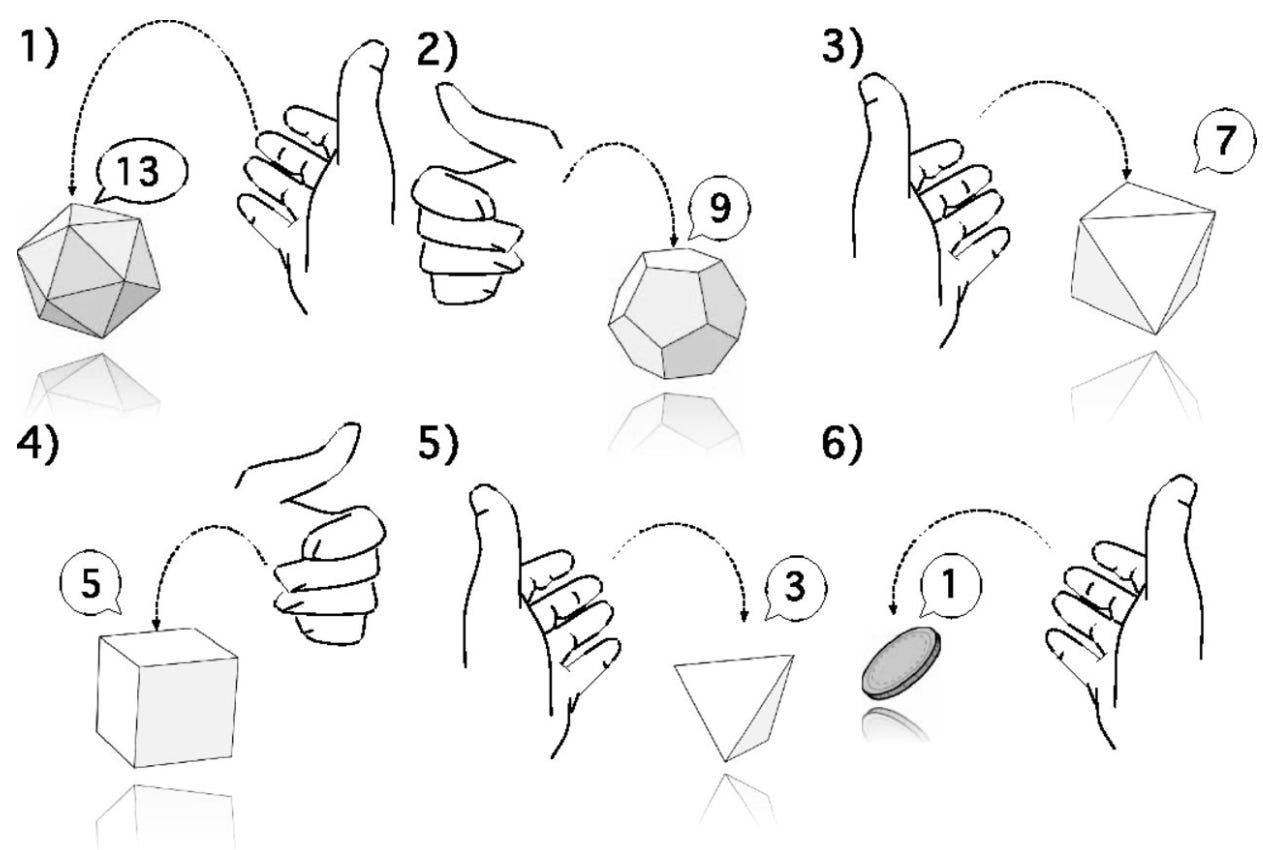
SSRs are “history dependent” processes, of which there are many in real life. For example, when you build a sentence word-by-word, prior word choices sample space reduce later word choices. This makes SSRs very much non-Markovian (unlike me: my goal is to be Markovian :D).
Simulating SSRs
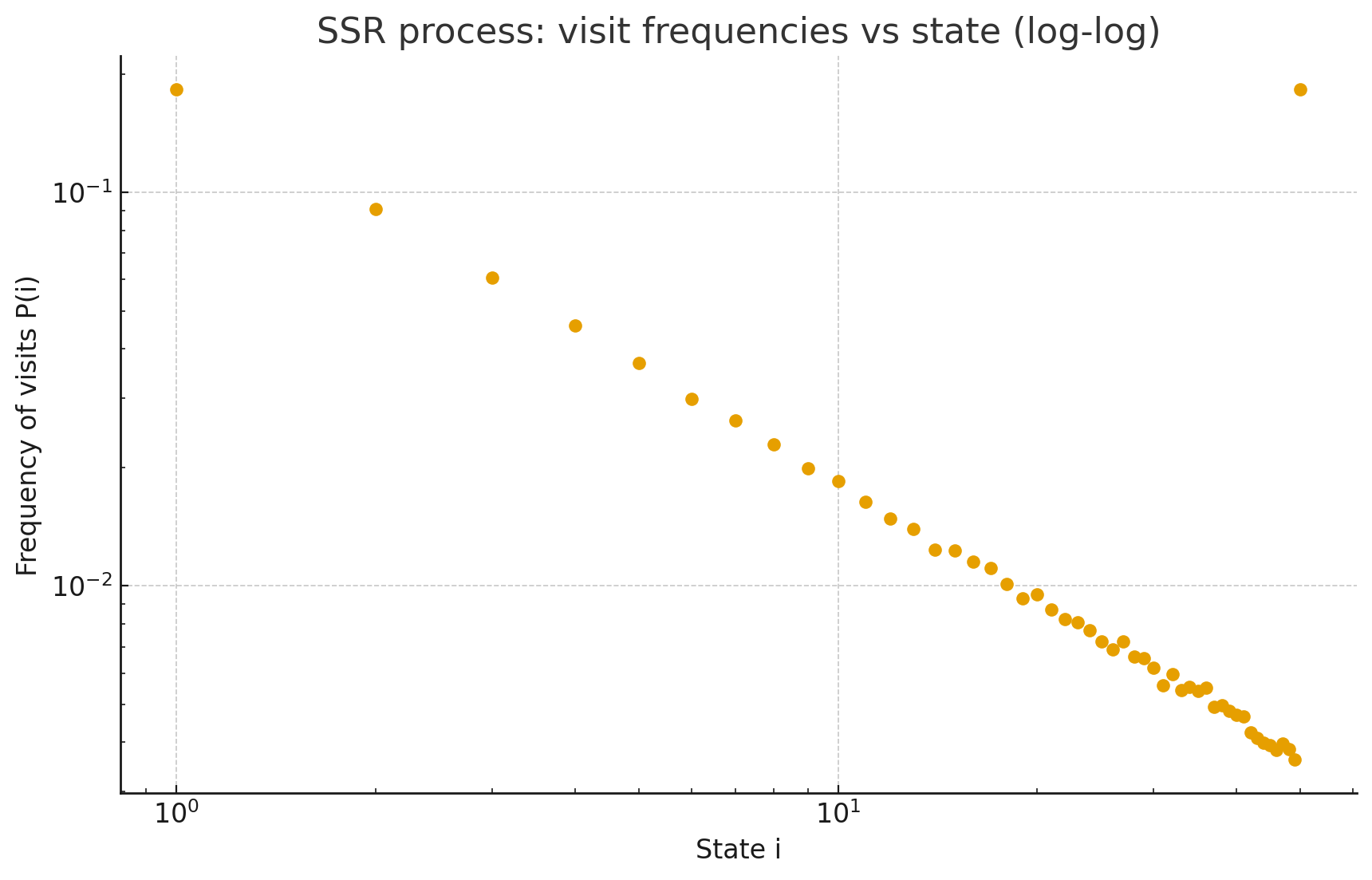
Below is a simple simulation I’ve written which shows power-laws emerging from SSRs. The simulation is:
States: 1, …, N = 50.
Start at N.
From state k, jump uniformly to any integer in {1, …, k − 1}.
Stop when you hit 1.
Repeat this whole trajectory many times (here 20,000 runs) and count how often each state is visited.
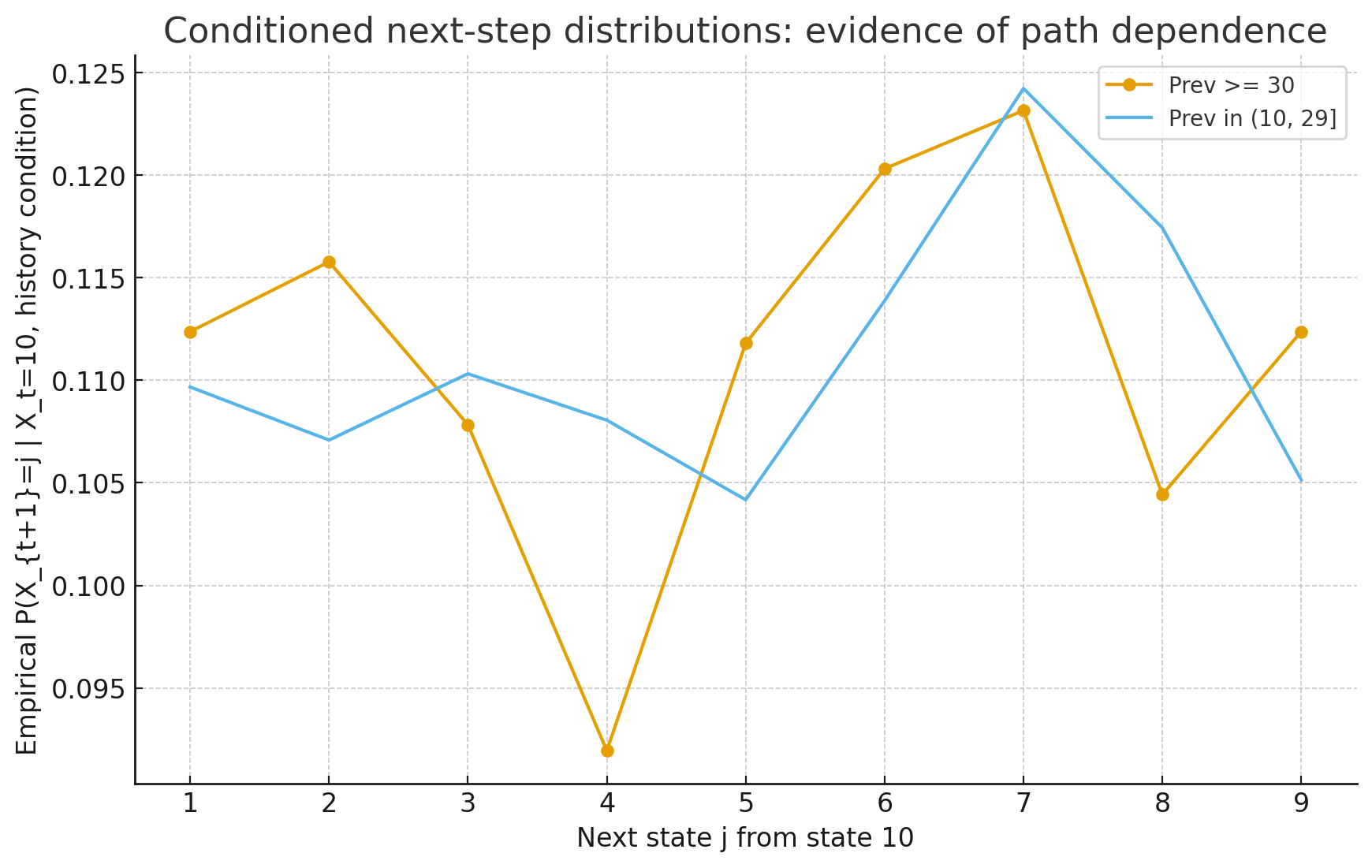
SSRs and Machine Learning
Autoregressive language models are SSR processes. Autoregressive transformers start with full vocabulary, and at each token the effective support shrinks because:
grammar restricts options
semantic constraints restrict options
discourse structure restricts options
This is clearly sample space reduction.
However, this picture is complicated by empirical reality. This paper shows that LLM outputs do not obey Zipf’s law. It occurs to me that this could be due to mode-collapse. It would be interesting to investigate further why there is such a divergence between natural language and LLM outputs (message me if you work on this).
For now it seems that the relevance of SSRs to understanding LLMs is limited. I’m filing this for now under The Delmore Effect.
Margarita Lovelace
I have five thoughts about Moby-Dick to tell you.
I.
My first thought is: just who the hell do I think I am to talk about Moby-Dick? My boyfriend has written an amazing thesis about Moby-Dick. His online gamer tag is “MobyDickInABox”, which comes from a place of chaotic energy that I enjoy cultivating too. He says it’s the great American novel, and that it is “for everyone”. My friends also egg me on to write about it. I’m getting all this permission from those who love me, so why shouldn’t I just take the leap?
I want to talk about this sophisticated book in a sophisticated manner. But when I try to do that I think I just end up revealing that I have potato salad for brains. So instead we’re going to look at Moby-Dick from my peripheral vision, as if we’re side-eyeing a particularly gorgeous, sexy, skittish person we don’t want to scare off by staring directly at them.
Eventually I’ll fully embrace Moby-Dick with all-out Venus energy, which will allow me to write about it in the way I want. But for now, we’re doing this.
II.
Ishmael and Queequeg sleeping together is very romantic. This scene really shows you what domestic life is all about:
We had lain thus in bed, chatting and napping at short intervals, and Queequeg now and then affectionately throwing his brown tattooed legs over mine, and then drawing them back; so entirely sociable and free and easy were we; when, at last, by reason of our confabulations, what little nappishness remained in us altogether departed, and we felt like getting up again, though day-break was yet some way down the future.
Yes, we became very wakeful; so much so that our recumbent position began to grow wearisome, and by little and little we found ourselves sitting up; the clothes well tucked around us, leaning against the head-board with our four knees drawn up close together, and our two noses bending over them, as if our kneepans were warming-pans. We felt very nice and snug, the more so since it was so chilly out of doors; indeed out of bed-clothes too, seeing that there was no fire in the room. The more so, I say, because truly to enjoy bodily warmth, some small part of you must be cold, for there is no quality in this world that is not what it is merely by contrast. Nothing exists in itself. If you flatter yourself that you are all over comfortable, and have been so a long time, then you cannot be said to be comfortable any more. But if, like Queequeg and me in the bed, the tip of your nose or the crown of your head be slightly chilled, why then, indeed, in the general consciousness you feel most delightfully and unmistakably warm. For this reason a sleeping apartment should never be furnished with a fire, which is one of the luxurious discomforts of the rich. For the height of this sort of deliciousness is to have nothing but the blanket between you and your snugness and the cold of the outer air. Then there you lie like the one warm spark in the heart of an arctic crystal.
Everyone in the world should get at least one chance to feel like the one warm spark in the heart of an arctic crystal. This adds a new layer to the art of the Enchanted Home. Once your home is tidy, aesthetically legible, and filled with creature comforts and nice nooks to settle into, you should change the elements inside it every couple of days. Like you are a cat, surrounded by novel curiosities.
One such legible change could be to turn the heat down, all the way off. Break out the blankets, the sweaters, the fires, the cuddling, the cocoa. Shiver a little. Become the warm spark.
III.
Cetology is powerful.
Thus speak of the whale, the great Cuvier, and John Hunter, and Lesson, those lights of zoology and anatomy. Nevertheless, though of real knowledge there be little, yet of books there are a plenty; and so in some small degree, with cetology, or the science of whales. Many are the men, small and great, old and new, landsmen and seamen, who have at large or in little, written of the whale. Run over a few:—The Authors of the Bible; Aristotle; Pliny; Aldrovandi; Sir Thomas Browne; Gesner; Ray; Linnæus; Rondeletius; Willoughby; Green; Artedi; Sibbald; Brisson; Marten; Lacépède; Bonneterre; Desmarest; Baron Cuvier; Frederick Cuvier; John Hunter; Owen; Scoresby; Beale; Bennett; J. Ross Browne; the Author of Miriam Coffin; Olmstead; and the Rev. T. Cheever. But to what ultimate generalizing purpose all these have written, the above cited extracts will show.
…
Next: how shall we define the whale, by his obvious externals, so as conspicuously to label him for all time to come? To be short, then, a whale is a spouting fish with a horizontal tail. There you have him. However contracted, that definition is the result of expanded meditation. A walrus spouts much like a whale, but the walrus is not a fish, because he is amphibious. But the last term of the definition is still more cogent, as coupled with the first. Almost any one must have noticed that all the fish familiar to landsmen have not a flat, but a vertical, or up-and-down tail. Whereas, among spouting fish the tail, though it may be similarly shaped, invariably assumes a horizontal position.
By the above definition of what a whale is, I do by no means exclude from the leviathanic brotherhood any sea creature hitherto identified with the whale by the best informed Nantucketers; nor, on the other hand, link with it any fish hitherto authoritatively regarded as alien. Hence, all the smaller, spouting, and horizontal tailed fish must be included in this ground-plan of Cetology. Now, then, come the grand divisions of the entire whale host.
And then Melville goes into great, autistic detail taxonomizing all the whales. Many people are bored by this chapter, but it is very important. When doing cartomancy, sometimes you draw The Magician or The Hierophant. These cards are calling out to you, enjoining you to pursue knowledge. Sometimes you do actually have to try to know everything there is to know about something before you can know what it is really like to be that something. So Ishmael here needs to read every book about whales that has ever been written, and he needs to tell us about it.
Everyone needs to be a cetologist about something.
I think of myself as a cetologist of love. I want to know about every single way, every single variation that one person has to love another. One day, I will list them out in a big taxonomy and sort them folio, octavo, and duodecimo like Ishmael did with the whales.
IV.
Who in Moby-Dick is the Magician, the Warrior, the King, and the Lover?
The Magician is: Fedallah.
“How old do you suppose Fedallah is, Stubb?”
“Do you see that mainmast there?” pointing to the ship; “well, that’s the figure one; now take all the hoops in the Pequod’s hold, and string along in a row with that mast, for oughts, do you see; well, that wouldn’t begin to be Fedallah’s age. Nor all the coopers in creation couldn’t show hoops enough to make oughts enough.”
“But see here, Stubb, I thought you a little boasted just now, that you meant to give Fedallah a sea-toss, if you got a good chance. Now, if he’s so old as all those hoops of yours come to, and if he is going to live for ever, what good will it do to pitch him overboard—tell me that?
Immortal and arcane. He hears spirits.
The Warrior is: Queequeg.
The King is: Ahab.
The Lover is: Ishmael.
V.
It is important to understand Ahab.
The following Ahabisms are a bit long, but you have to soak it in:
’Twas not so hard a task. I thought to find one stubborn, at the least; but my one cogged circle fits into all their various wheels, and they revolve. Or, if you will, like so many ant-hills of powder, they all stand before me; and I their match. Oh, hard! that to fire others, the match itself must needs be wasting! What I’ve dared, I’ve willed; and what I’ve willed, I’ll do! They think me mad—Starbuck does; but I’m demoniac, I am madness maddened! That wild madness that’s only calm to comprehend itself! The prophecy was that I should be dismembered; and—Aye! I lost this leg. I now prophesy that I will dismember my dismemberer. Now, then, be the prophet and the fulfiller one. That’s more than ye, ye great gods, ever were. I laugh and hoot at ye, ye cricket-players, ye pugilists, ye deaf Burkes and blinded Bendigoes! I will not say as schoolboys do to bullies—Take some one of your own size; don’t pommel me! No, ye’ve knocked me down, and I am up again; but ye have run and hidden. Come forth from behind your cotton bags! I have no long gun to reach ye. Come, Ahab’s compliments to ye; come and see if ye can swerve me. Swerve me? ye cannot swerve me, else ye swerve yourselves! man has ye there. Swerve me? The path to my fixed purpose is laid with iron rails, whereon my soul is grooved to run. Over unsounded gorges, through the rifled hearts of mountains, under torrents’ beds, unerringly I rush! Naught’s an obstacle, naught’s an angle to the iron way!
“Talk not to me of blasphemy, man; I’d strike the sun if it insulted me.”
“I turn my body from the sun. What ho, Tashtego! let me hear thy hammer. Oh! ye three unsurrendered spires of mine; thou uncracked keel; and only god-bullied hull; thou firm deck, and haughty helm, and Pole-pointed prow,—death-glorious ship! must ye then perish, and without me? Am I cut off from the last fond pride of meanest shipwrecked captains? Oh, lonely death on lonely life! Oh, now I feel my topmost greatness lies in my topmost grief. Ho, ho! from all your furthest bounds, pour ye now in, ye bold billows of my whole foregone life, and top this one piled comber of my death! Towards thee I roll, thou all-destroying but unconquering whale; to the last I grapple with thee; from hell’s heart I stab at thee; for hate’s sake I spit my last breath at thee. Sink all coffins and all hearses to one common pool! and since neither can be mine, let me then tow to pieces, while still chasing thee, though tied to thee, thou damned whale! Thus, I give up the spear!”
Boyfriends love being Ahab. If you can’t understand Ahab, it is hard to understand boyfriends. Study Ahab to study love.
Markus Strasser
404
Not Found
Michael Dickens

Was Ozymandias’s plan in The Watchmen morally justified? Did the ends justify the means? Do his actions illustrate that something is wrong with Utilitarianism?
First let’s understand what Ozymandias did and why he did it. He set off an explosion in New York City that killed 3 million people, and he made the world believe that aliens did it. He did this in order to force the USA and the USSR to end the cold war and to unite humanity under a common enemy. He realized that without a common enemy, the world would soon be engulfed in nuclear Armageddon. So, he killed 3 million people to save over 7 billion people. Was he justified? It seems like if we are act utilitarians we must say that he is, because all that matters is that his actions were massively net positive in expected lives saved.
However, to affirm that would be to misunderstand what Utilitarianism is about. I’ve argued this previously in my piece “Utilitarianism Isn’t About Doing Bad Things for the Greater Good. It’s About Doing the Most Good”. Utilitarianism is about your obligation to do the most good at the margin, it isn’t about justifying doing bad thing in order to cause good things to happen (you may have to do that when all other options are exhausted). So, if Watchmen is supposed to be taken to be some sort of indictment of Utilitarianism, it must show that Ozymandias did in fact do the most good he could at the margin.
But that is just very obviously not the case. There were so many ways Ozymandias could have achieved the same end via superior means. I will list a few:
Ozymandias could have done his false flag operation somewhere else without killing any people. A hydrogen-bomb-sized alien attack in the middle of Antarctica is still scary enough to force international cooperation.
Ozymandias is allies with Dr. Manhattan, who is basically an omnipotent being. Dr. Manhattan is indifferent to humanity, but Ozymandias is smart enough to know how to manipulate him. Ozymandias could have subtly coerced Dr. Manhattan into doing any of the following things:
Dr. Manhattan could act as an external “nuclear deterrent” to both the United States and the USSR, which would prevent war.
Dr. Manhattan could make the whole world wealthier by creating infinite food, medicine, and energy — rendering great power conflict significantly less appealing. Global energy is very typically at the root of international conflict, and disrupting the energy supply creates enormous leverage to displace bad governance.
Dr. Manhattan could delete every nuclear weapon on Earth, lowering existential risk.
Ozymandias himself could do most of the above without Dr. Manhattan. He is the smartest man in the world (besides Dr. Manhattan) as well as the wealthiest. He clearly has enough agency to hatch a plan that would allow him to destroy all nuclear weapons (perhaps through sabotage and espionage).
So no, Ozymandias’s plan is not justified by Utilitarianism. It seems clear even in-universe that he is an egomaniac with bad ideas.
In general, I would advise against letting fiction directly persuade you on important ethical questions. Some fictional scenarios are fine as illustrative examples of philosophical ideas, but most stories do not contain ethical ideas that are internally coherent and shouldn’t be treated like they are data.
Mikhail Samin
Logical decision theories prove that it is rational to bihack yourself.
Decision theory is a guide to rationality, and rationality is about winning. Having a lot of fun sex and having more chances to fall in love is an important aspect of winning. Any ideology that tells you not to bihack should be consigned to the flames.
To be clear, causal decision theory also gives you reason to bihack: increasing your sexual optionality will cause an increase in expected utility. Evidential decision theory also gives you reasons to bihack, since the ‘news value’ of bisexuality is high.
But there is an additional layer of reasons to bihack which only exist within logical decision theories. As a reminder, logical decision theories ask you to make decisions as if you were controlling the logical output of your decision algorithm. If you are making a decision about whether or not to bihack, you can think of yourself as making a choice on behalf of all agents in your algorithmic reference class. Due to lack of bisexuality, there are many pairs of such agents which are unable to have sex with each other. Therefore, when choosing to bihack for LDT-reasons, you are enabling all pairs of agents within your class to have sex with each other. This unlocks a lot of utility.
Of course, for this reason you should be strongly willing to have sex with yourself. I am currently self-modifying to enable this preference.
There is a generalization of bihacking that is also called for. If you’ve bihacked yourself but you’re only interested in sleeping with catgirls and catboys, then you are still leaving hundred dollar bills on the street. You should expand your sexual tastes to include all rational agents (i.e. you need to be omnihacking). I wrote earlier about how I want someone to bio-engineer unicorns into existence. Specifically, it would be best if we brought unicorns into existence who were also capable of acting on LDT, and then have both humans and unicorns omnihacked to be sexually compatible.
Nikola Jurkovic
Earlier I wrote that most disagreements about the importance of AI Safety are driven by disagreements over AI timelines. It does not make sense to attempt to directly persuade someone on AI safety priorities if your timelines are not close in the first place. Which research agendas are worth pursuing? The answer to this will vary greatly between a person who believes AGI will come within 10 years, and another who believes it will come in 100 years.
This difference is what matters most when it comes to explicit disagreement. I believe there are also some separate sources of implicit disagreement which can prevent persuasion. By “implicit beliefs” I mean action-guiding attitudes which you either don’t endorse rationally or are not fully aware of. For example, say you have a high P(DOOM) but do not “feel” that it is likely that the world will end (i.e. you believe the risk is high but you alieve the risk is low). You may continue to make decisions that make more sense under long timelines (e.g. investing in treasury bonds, applying to PhD programs, have children) due to your aliefs. Many who are like this assume that they just have high akrasia, but I believe the principal difficulty is that existential risks are hard to alieve for many people.
Why might AI doom be difficult to alieve? I identify some reasons:
AGI risk is one-shot, unlike other risks such as nuclear weapons. People all over the world fear nuclear weapons. For decades, schoolchildren would have to do nuclear weapon preparedness tests that involved hiding under their desks. But the salience of atomic weapons is assisted by having real world examples of their use. Artificial general intelligence will not be that way. Misalignment will likely lock-in after a certain point, making it uniquely important that this problem be solved correctly ex ante without using the iterative problem-solving methods that characterized most engineering.
Intelligence is unlike other technologies. Most non-weapon technologies are non-zero-sum and help the world flourish in one way or another. It is a good heuristic to bet on technological and economic growth in general for this reason. But intelligence is unique, in that it adds self-improving agents into the world.
The just-world fallacy. Many alieve that people get what they deserve. Even when it comes to imagining apocalyptic scenarios, we like to imagine that everyone “gets what they deserve”. This makes it difficult to imagine the most likely AGI ruin scenarios, where organic life completely dies out and is supplanted by artificial minds that are not directly malicious. The AI does not hate you. This runs strongly counter to our narrative intuitions about how just deserts.
What can one do to align one’s beliefs and aliefs on AGI risk? I suggest reading and writing different takeover scenarios and reflecting on their commonalities and differences, and watching (and critiquing) stories about AGI in general. I would also recommend giving yourself proper time and space to grieve the life you may be losing. Part of not alieving in AGI ruin comes from not wanting to believe that the “normal future” you desired is not yours to have.
I will not pretend that I’ve figured out all my feelings about this, but I know that it is important to not let my aliefs stunt my beliefs.
Raye
I dont know yet what it is that I want to say but whatever it is I know roughly how I want to say it I have become skeptical of punctuation I have come to believe that there is no punctuation in the brain or at least im coming around to believing that there is no punctuation in my brain maybe there is in yours but i will have to check myself before i can be sure I tried a little while ago to build a beautiful BCI prototype and I still think I can I still have all the parts all i need is a little elbow grease and a bit more knowhow and then i will be able to check if there is punctuation in the brain for sure At least when i introspect i feel the words start nowhere and end nowhere but instead form a torus that twists and twists and twists around and around like a merrygoround and the words flow in and out of each other I dont understand what good style is I would like to know what it is Especially because i want to be able to read my own work and be proud of it and understand it and feel like it really got the heart of the matter and didnt talk around and around like a merrygoround and miss the point entirely I think it will take me ten years to learn how to do this Or it could take ten days if i talk to the right people like scott alexander and others who maybe do have punctuation in their brains In any case i wont figure it out today because i need to go out again Partiful will be the death of me no more partying in sf i say I look at all the rsvps ive stacked up and start thinking that its time to just hit the road and drive maybe down to mexico city or maybe i get the cheapest ticket i can to berlin but berlin also seems like a partiful city so id be back to square one pretty quickly i will miss my adventures with aella but she gets it Comfort is death and here we dont worship death i def agree with yudkowsky about that Im actually realizing that i think shenzhen is in my futurethefuture is not equally distributed they say and if im chasing myself out of sf then shenzhen must be the place to be i read online that the tech companies there hire women to play pingpong and cheer on the engineers while theyre coding and they teach them how to speak to women and maybe i could quickly get a job like that but really that would be awful because i want to do the engineering and id want someone to cheer me on and so on Im not scared to do the hard work thats why i went to tsmc i wanted to feel the future in my hands the future is not going to be going to mushroom and costume parties its going to be studying linear algebra with the girlies and making wearables that are actually wearable its going to be ai agents and coasian bargaining its going to be egg freezing parties its going to be immortality or the end of all things Ill be sad leaving behind all my unassembled bci parts but its important to travel light and to learn how to leave and to not wait until it feels right because by then it will be way way too late and besides its not like i will have a hard time buying those parts again in shenzhen where i will learn and i will build and i will prototype and i will redesign and i will learn good style if not in english then in mandarin and i will definitely either know how punctuation works or i will make my perfect bci veils that will make me look like a reverend mother and we will be able to communicate mind to mind directly without the need for any punctuation
Rob Miles
There are a lot of ordinary objects with surprising geometric properties.

Here is some kale. It has negative Gaussian curvature. In order words, it is a hyperbolic surface. You can think of a hyperbolic surface as one that would be flat, but we decided to cram so much stuff in it that it’s forced to buckle outwards. If you were to try to flatten kale, it would tear. Why does this happen? This question is ambiguous, but one way to answer is that in kale the growth at the edges is faster than growth at the interior. Many biological forms grow in this way.

What is life like on a hyperbolic plane?
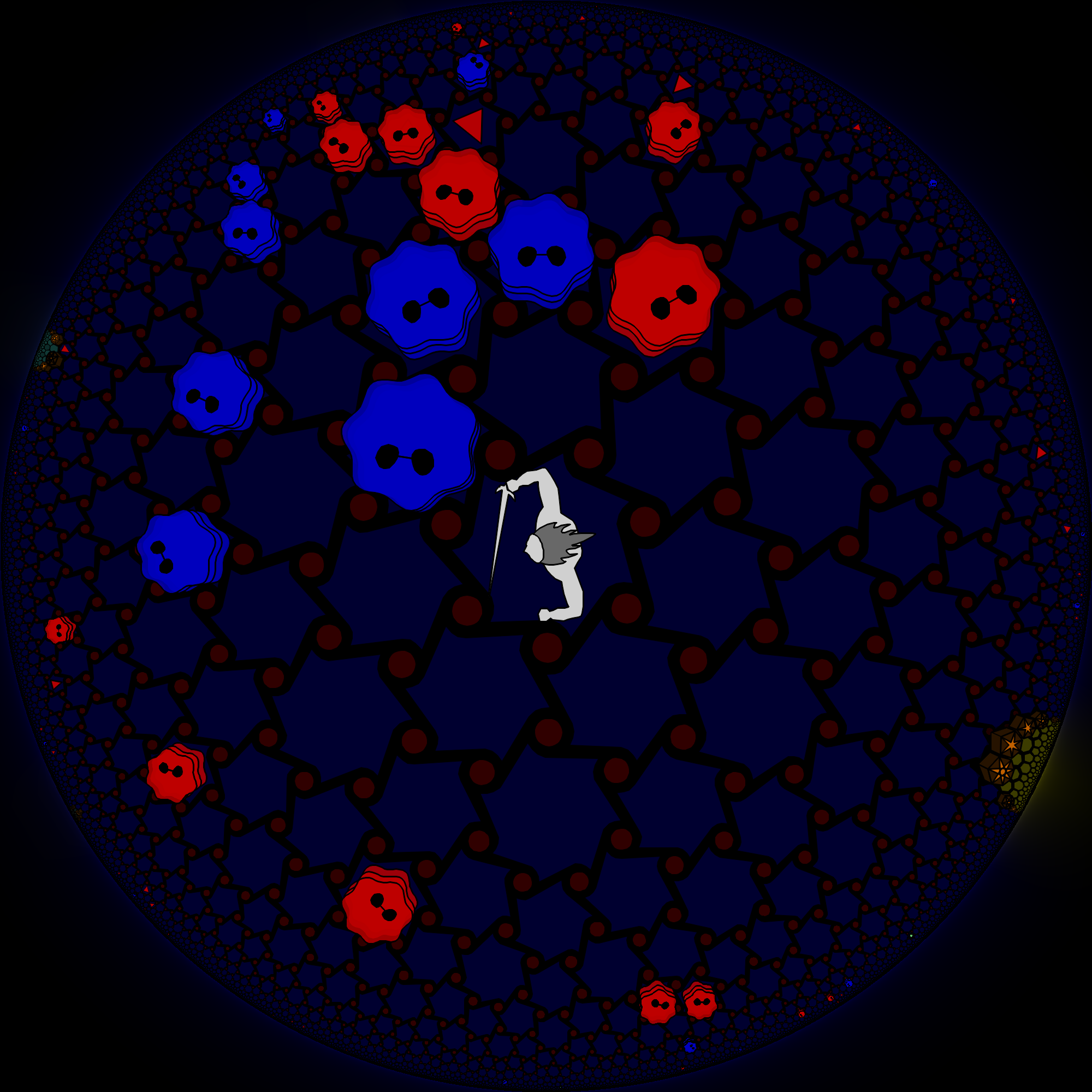
The video game HyperRouge can give you some intuitions. All of space bends away from you the further away it gets. This makes it really hard to walk in a straight line and then turn around to come back whence you came. Even a little bit of error will send you hurtling off in a completely wrong direction.
These are negative Gaussian curvature spaces. Euclidean planes are zero Gaussian curvature spaces. Spheres have positive Gaussian curvature (they have too little area, so it curves in on itself). All of this is intrinsic curvature, i.e. the curvature of the space as whole.
There is another concept called the extrinsic curvature, which is how a surface bends inside a surrounding space. There are a lot of wacky and exciting things that happens with extrinsic curvature.
Take soap bubbles for instance.

The “goal” of a soap bubble is to minimize its own area given a volume constraint. If the extrinsic curvature of the bubble is positive, then there is outward pressure and the bubble expands. If there is negative extrinsic curvature the bubble collapses down. Stable bubbles have mean extrinsic curvature of 0. They are what’s called “minimal surfaces”.
Here’s another soapy minimal surface, built around an odd structure:

Though it may not be obvious, the extrinsic curvature of this helical bubble is still 0. The same is true of these bubble clusters:
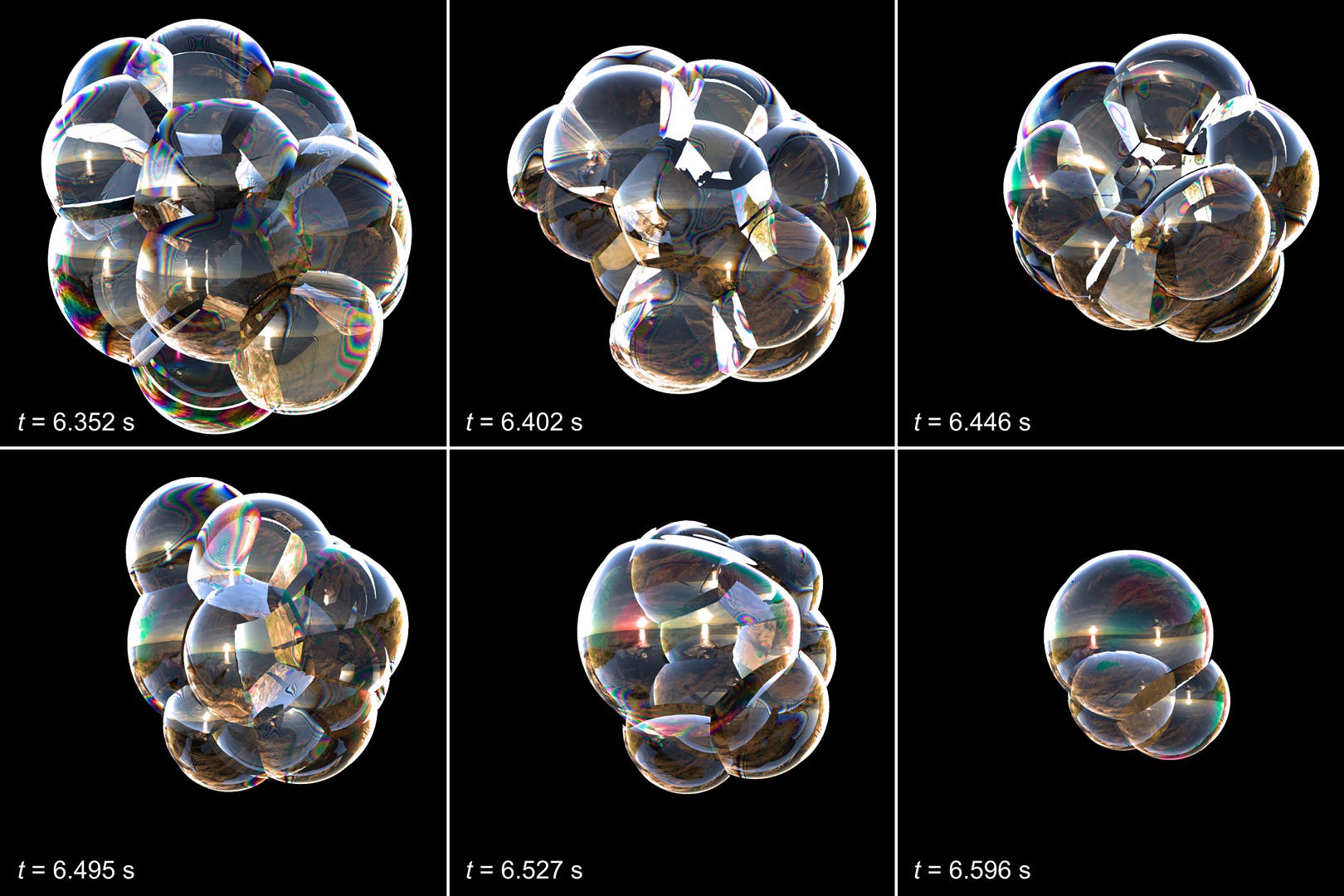
This is very delightful, and most surprising! These bubble clusters follow another set of rules called Plateau’s laws, which every bubble cluster, every foam, every soap film on planet Earth obey:
They are minimal surfaces
Three films meet at edges called “Plateau borders” at 120 degrees.
The Pleateau borders meet four at a time at vertices as edges of a tetrahedron.

This photo shows Plateau’s laws a bit more clearly: any three adjacent bubbles meet at an edge at 120 degrees, and any four adjacent edges are shaped like the angles of a tetrahedron.
I have poked around to try and understand how this generalizes in the fourth dimension, but it’s a bit beyond me at the moment. Three dimensions are enough for me (for now)!
Sasha Putilin
I shoved 300 mg of mephedrone up my asshole and then did zazen mediation for three hours.
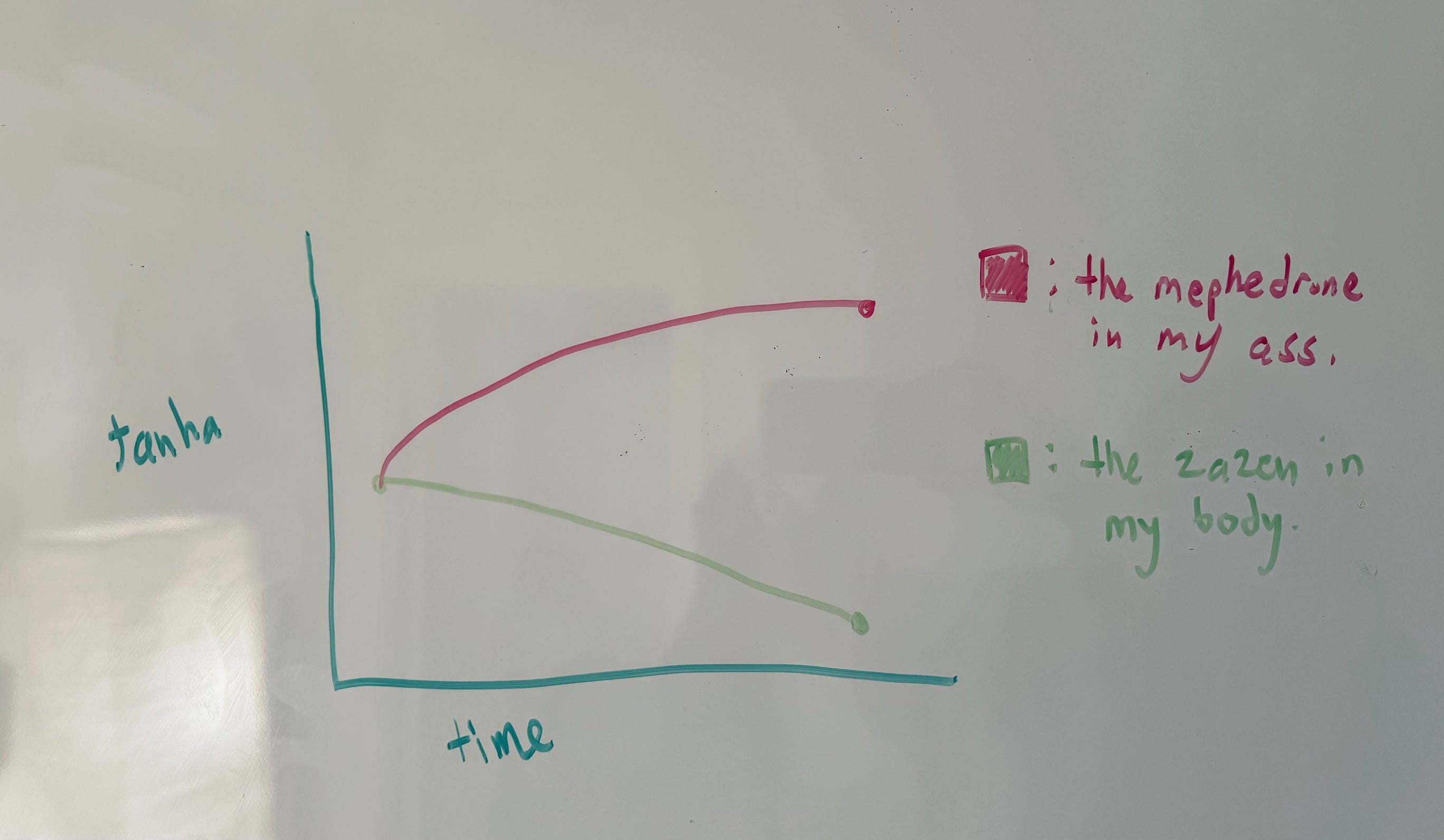
Why mephedrone? It is MDMA for doomscrollers. Once you snort it you don’t stop snorting it for 12-36 hours. You don’t become addicted (typically) and it isn’t neurotoxic, but you will stay on the rails until your capacity for desire is completely depleted. Why up my asshole? Rectal administration has a smoother but faster ramp up. And besides, my nostrils have gotten tired. Why zazen? I want to escape the vice-like grip of kama-tanha that mephedrone imposes on me. It is a lot of fun to jerk off for twelve hours on mephedrone, but I want to do it on my terms I guess. The Dhammacakkappavattana Sutta said:
Bhikkhus, there is a noble truth about the cessation of suffering. It is the complete fading away and cessation of taṇhā; its abandonment and relinquishment; getting free from and being independent of it.
The ramp up predictably was quite nice. I feel the entactogens permeate the wall of my rectum, enter my bloodstream, work their way up to my brain, and then gently assault my neurons. Over the course of thirty minutes I go from placid and flaccid to hot and horny. I observe becoming upset that my cock isn’t out. But I still sit. I begin talking to various parts of my body, and I discover that they are reacting to the situation in different ways. The detachment I get from zazen doesn’t cancel out the how horny the mephedrone is making me, but there is wave interference:
When I’m finished meditating, I’m still slightly pissed that I haven’t snorted more mephedrone and didn’t get to jerk off. I start talking to my muscle groups to see what they think. They are mostly fine going without further anal infusions (after all, mind-altering substances alter the mind, not the muscles). They are mainly upset that we haven’t deadlifted in three weeks, so I walk to the gym and do that. By the time I finished working I feel totally fine, no mephedrone needed. Success!
If you are reading this and you are a sweet babygirl who is curious about me and/or horny, DM me.
Skyler
So you want to master rationality? Do you think of that as a goal?
In my culture, this is a mistake. Rationality is not a goal, it is a method. It isn’t a result, it is a tool. Most of us don’t need more goals, we need more tools.
Wizard power is neat. There should be more of it in the world. But wizard power is always a means and not an end. If all you want is to be surrounded by as much wizard power as possible, you are Goodharting your life and will find yourself soon surrounded by Death Eaters.
If you’re reading this on LessWrong, this point is probably already obvious to you on paper. Nevertheless, I know all too many rationalists who have mistakenly flipped their values upside-down by turning rationality into the goal (I think you too know people who’ve done this). Some then go on to over-correct, and then turn anti-rationality into the goal (I think you also know people like this).
Rationality isn’t the treasure. Rationality is the map.
Why do people make this mistake? I have some ideas.
I.
Human psychology has a bug: we’re really, really bad at keeping means and ends straight.
Want to read a lot? Great. Beware of buying books and e-readers instead of actually reading.
Want to get in shape? Great. Beware of buying a bunch of shiny new gym clothes, a Fitbit, and an expensive gym membership instead of working out hard.
Want to think clearly? Great. Beware of hoarding frameworks, reading 200 blog posts on Bayes’ rule, and getting into Twitter fights about priors, instead of actually improving your life.
Rationality is especially vulnerable to this because it’s so easy to look rational without ever spending the cognitive calories it takes to actually be rational. And because the performance looks good, you feel productive. You feel safe. You feel like you’re doing the Work. You get to sit in the dojo in your nice gi, so you no longer feel like you have to do your kata.
II.
And then there’s the social reward problem. People don’t like admitting this, but one of the biggest perks of identifying as “rational” is that you get to feel like you’re smarter than the average bear.
You have a community that values cleverness. You get applause for the right references. You get brownie points for eloquent analysis. These rewards aren’t evil, but they do distort incentives. People can use the words, but not understand the models.
If your social rewards come from seeming rational, then the optimal strategy shifts from “achieve your goals using clear thinking” to “display enough rationality-signaling behaviors to maintain status.”
This includes behaviors like the charge of the hobby horse. It’s rationality as cosplay.
III.
And then there’s the comfort of epistemic rituals.
Rationality rituals feel safe. When life is chaotic, uncertain, and full of emotional landmines, epistemic routines can help us feel in control. It’s “productive distraction”. Sometimes this is basically benign (e.g. the Delmore effect). Sometimes this leads to disaster.
IV.
So what’s the solution?
We need rationality dojos. A place to practice rationality every day, a little bit at a time. No showing off, no status games. Just rationality kata. A little dose of Bayes. A little bit of Fermi estimation. A short stretch of goal factoring. A daily session of Murphyjitsu.
It’s through processes like this that we can be confident in producing real rationality black-belts.
Tomás Bjartur
I have it pinched between both my thumbs and both my pointer fingers, trembling. I fear I’ll stain it with my sweat, even though I know that is impossible. “Congratulations!” Seventeen years of serial, orbital-time man-hours. A thousand product launches, a thousand little humiliations. “Congrats man!” And now I have it. I’m holding it. “Congratulations!” My first Ticket. “Well deserved, look at you…” My slice of the lightcone.
My insipid coworkers decorated the office with signs that read “YOU THE MAN DENNIS”, “DENNIS THE MENACE”, and “HAPPY ROOTING”. I like imagining their faces attached to little lemming bodies, waddling off a nearby cliff.
An outstretched hand comes into focus. I shake it using my right hand, which I have allowed to temporarily let go of the BCP node voucher. It belongs to Quinquagesema — my boss. The head of the division for Sub-Industrial Redesign, and 5th generation nodal descendant of Over-CEO Evart Patchouli. She is smiling at me beneficently. Her face is an untouched lake. It was never explained to me why all of Patchouli’s nodes are women — that is not a topic of discussion.
Thirty minutes later I’m in line at the Bureau of Corporeal Production, still pinching my voucher with both hands. Myself and four others are waiting to be assigned a case officer who will help us navigate the arcane paperwork involved in minting our first nodes. Obviously, I came prepared. I know exactly what I want my node to look like, what I want them to be. Ever since I was six I’d fantasize about having a twin brother to do everything with. We’d share it all. I’d be perfectly understood, without having to the simian ritual of explaining myself (as I had to with the simpleton who birthed me). So now, at 35, that’s what I’ll have. My first node will be raw. No edits. No, I won’t even remove my astigmatism. Once you start making compromises like that, where will it end? Quinquagesema (gorgeous, fastidious, athletic) is nothing like Evart (decrepit, lecherous, suspended in heavy water). The thought makes my penis ache. Of course, there will be a difference between me and Dennis-2: he will be legally sanctioned to spawn Ems. Through him I’ll join the Ascended Economy. Billions of DigiDennises doing what we do best.
A pretty case officer comes and takes my ticket. She’s taking notes and asking me about my node preferences. While I’m using my mouth to talk her through the vision, I am reserving most of my mental capacity to play for myself a high-resolution film of my glorious future: I’ll be sitting in my office sipping mojitos while Dennis-2 triages all of the day’s work; I’ll allow my favorite direct reports to use my Ems in exchange for naughty favors; Quinquagesema’s ems and mine will interface productively (and maybe not so productively too, hee hee). It’ll be wonderful having access to a legion of agents who will always do what you want them to do, but not because you’re forcing them, but because that’s what they were thinking too! Will always do anything you want them to do. Will do anything you want… Anything…
“So Mr. Quan, what sex will your node take?” Female. “And what will be her name?” Denise.
Gestation took one month, and behavioral calibration another. Finally, on coming home from work one day, I hear from outside the door of my apartment that someone has let themselves in. Must be Denise.
I enter, avoiding direct eye contact.
“I have converted the living room into a bedroom for myself” she explains. Perfect. I too think it would be best that we cohabitate for at least the first calendar year.
“Excellent” I say. I then go to my bedroom to fetch the file I’ve prepared for her which explains everything she needs to know about the structure and politics of the division of Sub-Industrial Redesign. I return, and upon handing her the folder, she stands up. I look her in the eyes. She is six inches shorter than me, and so, so beautiful. I instantly cum so hard that I go blind for two seconds.
“Excuse me.” I lock myself in the bathroom to clean up and to normalize my heart rate. I suspected this would happen. The nature of rooting is such that the Westermarck effect doesn’t take hold, and so I knew going into this that there would be some risk of being overcome by genetic sexual attraction. But I never thought it would be this intense. I was hoping to spend a full year whittling away at both of our inhibitions before attempting to inseminate her, but it seems like I will have to pull the timelines up.
I look in the mirror. All I see is a Chopped Unc.
I look down at my groin. I’ve washed up all the cum but I’m still “rock hard”.
“Please behave,” I say to Pennis.
“No, I don’t think I will,” he says to me.
I put my pants back on and try to tuck Pennis behind the inside of my thigh. So Denise won’t notice his insolent throbbing. I return to her bedroom to speak with her. She’s already finished reading the file.
“Good job. I knew you would read all that very quickly, but I’m still impressed. We will copulate tomorrow after work. Wear some erotic lingerie, and do the ahegao face when you orgasm. I am sleepy now, goodnight.” Denise processes all of this patiently.
One week later, and we still haven’t fucked. Denise covertly rented an apartment across town and snuck out in the middle of the night.
She was promoted quickly and was my boss for a day, but Quinquagesema felt this was inappropriate, so I received a lateral promotion. Denise’s explosive productivity means that I am on track to receive my second BCP node voucher by the end of the month. When we walk by each other in the office she gives me a polite nod. I have to impregnate her. I’ve learned from my mistake: my next node will be a man, a raw Dennis-2. Together we’ll figure out a way to set all of this right.
Vasco Queirós
I’m sorry to say but it’s over for us Europoors. It’s never, ever been more over. Forget building a new Rome. Forget building anything actually. We have thirty years of rubber dinghy rapids Islam to look forward to (do me a favor and follow kunley_drukpa on X). Now would be the time to sip the hemlock, but we haven’t earned the right to because our culture can’t produce a Socrates anymore. The forces of entropy and midwittery haven’t just captured “the cathedral”. The truth is so much worse: they’ve captured the memeplex. So — short of going full Mishima-mode on Brussels — we are left with one choice: to wage (defensive) infowar. This is what the Groypers think they’re doing, but in reality they are conjoined with the woketards in a toxoplasmic dyad. This is basic Slate Star Codex, go read that. Or go read Hegel, he said something about this too I think.
No, a defensive infowar means undoing this taxoplasma. Reverse the entropy of public discourse by selecting against the adverse selection that is putting screaming demons in front of the eyeballs of every teenager on Earth for eight hours a day every day. How to do dat? Don’t push directly back — just side-step. Being screamed at by a MAGA-cel? Don’t say you’re a liberal — you’re post-MAGA. What now? Wokie calling your employer? Fear not: you’re not reactionary, you’re post-liberal. It works. Nietzsche said that when walking from mountaintop to mountaintop, the overman does not descend into the valley — he grows long legs. Your legs don’t have to be as long as that, so grow them out and step around. It’s just language. Use it or be used by it.
What else should you do? Okay, unc talk: You should be cozy-maxxing. You should be pleasant to talk to. You should assume good faith. You should be fantasizing about Rome. You should be building beautiful things. You should demolish every single godless, Le Corbusier-inspired architectural monstrosity that’s been erected on this continent. Just kidding, don’t do that. But we really should wall all of that off with a yuge blanket so our children won’t have to see it.
You should be learning how to experience the jhanas. I’m serious: little by little, you can hard cap suffering permanently. It is not “woo”, don’t sneer. Pay attention. All the most high-performing, most cracked, most competitive cultures in the world are paying attention to this shit. Do you think it’s because all of them are so stupid, and you are so smart? Pay attention, like Hamlet did, and notice the cracks in the edifice of materialism. Find some edge, and then use it. Then you can let the infowar just wash over you, totally serene, with a big (and sort of stupid-looking) smile plastered on your face.
Ask yourself, what would happen if we did all of that? We wouldn’t have to move to America just to be around ambitious people. We wouldn’t have to leave and cede the continent to these total fucking, Euroslop losers whose highest ambition in life is to trick their therapists into declaring them unfit to work and in need of public assistance. We wouldn’t have to leave our friends and family behind. We wouldn’t have to be fucking POOR.
So first, let’s win the meme war. And then some time later — out of what will seem like nowhere — you’ll be walking down a boulevard with a fellow Eurobro, and one of you will turn to the other and say: “can you feel a vibe-shift?”
Europe was meant to be great.
Vishal Prasad
Me unga. Me bunga. Me unga bunga. Me lift weight. Me so strunga. Ahem. I could kill you with my bare hands by the way. I train jiujitsu. I could do anything to you. Ankle-pick you, pin you in side-control. Hit a super-duck on your oblivious ass. Whatever I want. It’s like if magic were real. I am Gandalf. And you are all my little hobbits. Oh you haven’t read Proust? Poor thing. A work of such gorgeousness and gorgeosity made flesh should not be left unread. The Guermantes Way has a four-hundred page description of a single walk Marcel took — you simply cannot say you have lived until you’ve read it. Hm? What’s that you say? You haven’t heard of Gevrey-Chambertin? That’s a wine. I drink that stuff. Quoth Wittgenstein, if a lion could whine we could not understand him. Har har har har. Did I tell you I used to do classical theater? Shakespeare. I can’t get enough of the Immortal Bard. And the channeling of him, and so on. You remind me of my mother — I mean, you remind me of Gertrude. Anyways, we do have to admit, ultimately, that Ben Jonson is the superior dramatist. Oh, you haven’t read him either? Oh dear… Have I told you about how unfair it is to be an Asian male? You don’t believe me? Perhaps you haven’t seen the data. According to the statistics I’ve crunched, you would be 15% more likely to have sex with me if I were white. Interesting right? I’m writing a piece about the first generation of Lisp machines. Heads up it’ll contain a lot of math. I’m a xoogler, after all. Machine learning engineer by the way. But don’t give up, I believe in you! I’m writing about lisp machines because I just have broad interests like that. Built different, they say. Sorry what did you ask? “How many FLOPS could a lisp machine execute?” Uh. Ah. Erm. Well you see… it’s complicated… Your post today was very interesting. Did I tell you that I read it? No? Well I did. It was excellent. I had many similar thoughts when I was younger. By the way, are you going to eat that?
I am ascending. Historians will say that Inkhaven was where Vishal Prasad began his apotheosis. I understand all there is to understand about you. Psychohistory is real, and I am its first practitioner. I have demonstrated the Gwernian thesis: the human psyche is highly compressible. If you fail to beta-upload, fear not: I will be uploaded, and you will live on through me.
William Friedman
The subject of Marie Antoinette’s wardrobe is a source of endless fascination for those of us who study it.
“I must dress as befits my rank so that I will be respected.”
So said Marie Antoinette to her mother, the Holy Roman Empress Maria Theresa, the mother-in-law of Europe. And indeed Marie Antoinette spoke from painful experience. The Viennese court of her youth was highly moralistic, and much modesty was expected of Hapsburg princesses. Unfortunately, these instincts, when brought to Versailles, earned her a reputation for being provincial, foreign, tasteless, and disrespectful to French artisans. This sort of malicious gossip could bring Marie Antoinette to but one conclusion: spend I shall, as spend I must.
Everything is noticed here, and I must avoid seeming either negligent or overly simple.
And so Marie Antoinette assembled one of history’s most lavish wardrobes. After Louis XVI’s coronation in 1775, Marie Antoinette’s budget de la garde-robe was officially 150,000 - 200,000 livres per year (or, approximately $5 million USD). In some season her overages tipped beyond 300,000 livres. She once spent 24,000 livres for a single hairstyle for a single event. We know these numbers in such detail because the invoices from her marchande de modes Rose Bertin are extant. Bertin, eager to line her pockets, was eager to stoke her Queen’s sartorial anxiety.
Marie Antoinette’s fashion choices were events of unparalleled political consequence. Caroline Weber, in Queen of Fashion, conveys this admirably:
To the Anglophobic French, a preference for British-made over domestic goods was offensive enough, especially while France was still at war with England in the American colonies. After the war ended in 1783, though, a new trade treaty with England flooded the French market with British textiles, and the Queen could no longer be singled out as their sole consumer. As “Anglomania” became a staple of French fashion — even the nation’s leading fashion journal was entitled Le Magasin des modes nouvelles françaises et anglaises — the public excoriated Marie Antoinette instead for importing muslins and linens from Hapsburg-controlled Belgium. Because Joseph II had recently undertaken a vigorous campaign to revitalize the Flemish textile industry, Marie Antoinette was accused of “revolutioniz[ing] French clothing and fashion” out of a treacherous “attachment to the commercial interests of her House.” Again tarring their sovereign with a xenophobic brush, observers fulminated that “the Autrichienne [was] conspiring to ruin our manufacturers of beautiful silks.”
The Queen occasionally erred by spending too little. When in 1783 she had a portrait displayed in the Paris Salon that depicted her in humble dress, the outcry was immediate and plural.

Some accused her of being “dressed up like a serving-maid”. One aristocrat excoriated his Queen:
Louis XIV would be rather surprised if he could see the wife of his great-grand-successor in the gown and apron of a country wench.
Henriette Campan, one of the waiting ladies, wrote that the Queen “had not imagined that such a simple dress could cause a scandal.”
Marie Antoinette received much blame for the fiscal excess of Louis XVI’s government. The royal court cost up to 10% of the entire French state budget. Compare this to the 5% of the Austrian court, and the 3% of the Prussian court. The British spent even less, thanks to Parliament’s control over the budget (herein lies a lesson for would-be monarchs: democracy can keep you safe). Louis XVI attempted many times to reduce Versailles’s burdenous budget, but he always failed. Revolutionary pamphleteers would lie and claim that the royal court cost 25% of the budget. Never let truth get in the way of justice!
Through such pamphleteers, the Bourbon line of monarchs begun in 1589 was severed. In 1791, Louis XVI and Marie Antoinette were arrested. In 1792, the republic was proclaimed. In January 1973, Louis XVI was executed. In October of that year, Marie Antoinette followed. Their two young children were held in captivity. The son died of tuberculosis in 1795 at the age of ten. The daughter, lived. During her imprisonment she was told her father was dead, but was not told what happened to the rest of her family. She scratched into the walls of her room:
Marie-Thérèse Charlotte is the most unhappy person in the world. She can obtain no news of her mother; nor be reunited to her, though she has asked it a thousand times. Live, my good mother! whom I love well, but of whom I can hear no tidings. O my father! watch over me from Heaven above. O my God! forgive those who have made my parents suffer.
After her arrest, and prior to her execution, Marie Antoinette wore humble clothes. She refused finery. At her execution she wore a white cotton chemise gown, a white petticoat, black shoes, a linen cap, a black ribbon around her neck, and no jewelry. History has invented for her the remark: “Finery has brought me too much misfortune.”
In many ways, Marie Antoinette was a scapegoat for Moloch: hated for spending too much, and scolded for spending too little. All across history we see dynamics similar to this play out. In today’s democracies, voters complain about taxes being too high, yet resent any attempt to cut government spending. I hope that the diligent study of history and economics will one day produce a wise and judicious voting public, who are capable of recognizing and remedying dangerous equilibria such as these. Alas, I am not holding my breath!
how did you even do this
P.S. I fully endorse the post that I wrote that you wrote. good argument
I'm not sure if this is the best Inkhaven post, but it's certainly the most Inkhaven of the Inkhaven posts.