
My Name

Names are useful objects for poetical riffing. William Shakespeare enjoyed incessantly punning on his name in his sonnets (“thy will”, “the willing loan”, “self-will’d”, “a willing patient”, “thy large ‘Will’”, and — with least subtlety — “my name is ‘Will’”). I often think of John Donne’s epigram about his in-laws’ attempts to annul his marriage to his wife Ann:
John Donne, Ann Donne, undone.
I was mislead into believing that a variant of this is on John Donne’s tombstone (“John Donne, a Donne, undone”), but sadly this is not the case.
When James Joyce feared he would predecease the completion of Finnegans Wake, he recruited his friend James Stephens as a back-up co-author. Stephens was chosen primarily for onomantic reasons: Joyce would have had the book’s byline read “JJ & S”, short for “Jameses Joyce & Stephens” (which is a riff on the Irish whiskey-makers “John Jameson & Sons”). Thankfully James Joyce managed to finish the book, and we can enjoy not reading it.
Vishal Vivek Prasad
My full name. Despite being half-Korean myself, my name is completely Indian.
Vishal is a male name which means great, grand, prominent, or expansive. My mom told me it means being great and large. A desi girlfriend in high school informed me it sounds like the name of a middle-aged actor (perhaps she was reminded of the mononymic Telugu actor Vishal). “Vishal” (/vɪʃɑːl/) is an iamb, so it sits comfortably in blank verse (in fact, my whole name is iambic). Growing up in Minnesota, sometimes my name would be misheard / misremembered as “Vishel”, “Michel”, or (atrociously) “Michelle”. This last misapprehension has made a resurgence recently due to people sometimes thinking that I am trying to present as female. In undergrad, one person consistently pronounced my name “Vee-shawl”. I am still frequently called “Vishul”. In middle school, friends would sometimes call me “Vishnu”, or “world destroyer” (even though Vishnu is the Preserver, and Shiva is the Destroyer). A girlfriend enjoyed calling me “Vee”, “V.V.P.”, and “Veepee”. I have never had to use a “White name”, because Vishal is so easy to pronounce in English.
Vivek means wisdom, conscience, or scholarliness. My Korean mother took charge of naming me. She believed “Vivek” means “scholar”, and consequently that my forenames mean “great scholar”; this is not quite right, but is correct enough. Vivek was originally intended to be my first name, but was exiled to the middle due to concerns over pronounceability (which proved well-founded, as most Americans pronounce Vivek Ramaswamy’s forename as “Vivik” instead of the correct “Vivayke”). My mom was also concerned that her Bihari in-laws wouldn’t be able to pronounce Vivek correctly, since in the Bihari accent “V”s are substituted with “B”s. Vivek is not a common name in my patrilinear jāti (i.e. the kayastha of Bihar and Odisha), and in general the name is found more in Western or Southern India. I attempted for the first two weeks of undergrad to switch my name socially to Vivek, but I just ended up confusing myself and stopped.
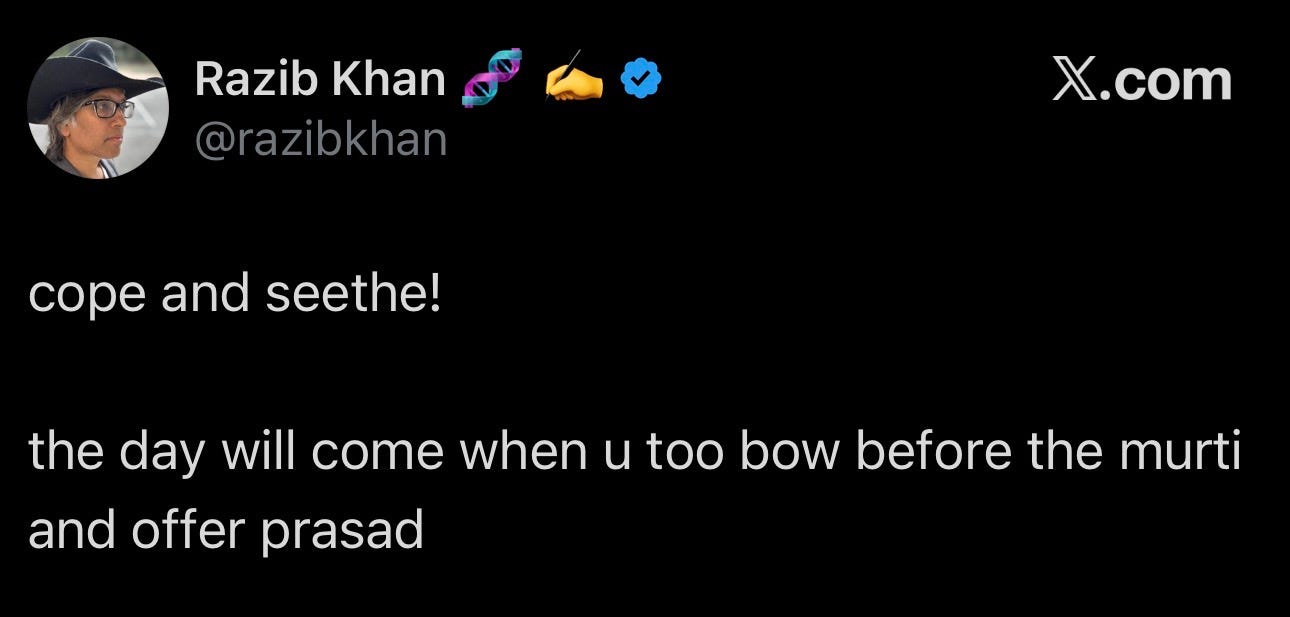
Prasad is a religious offering of food placed at a shrine of a deity. This word is slowly leaching into English. For example, here’s Razib doing a lil ragebaiting:
Priya Kim Prasad Bowe
My older sister’s full name. Now married to James Bowe III. Unlike me, she has a Korean middle name. My dada (i.e. paternal grandfather, i.e. my Indian grandfather) liked to call her “P.K.P., esteemèd daughter of B.K.P.”
Priya is a popular Indian girl’s name meaning beloved. Its Proto-Indo-European root is “priH-o-”, which appears in words related to loving or belonging. Following one branch, you get the Germanic frijaz, from which we get “free” (since the concept of freedom was associated in origin to belonging to a clan). Following another branch, you get the Æsir of love Frigg or Freiya, and from the former we derive friday (or “Frigg’s day”). “Pri” was my first word, and as a toddler I’d sputter it out whenever I was happy.
Kim (金) means “gold”. It is the most common Korean surname, and is my grandmother’s maiden name. My mother (who is something of an alt-feminist) despised the idea that her mother’s family history is to be condemned to dissipation due to patrilinear naming conventions, so she shoved that history into the middle of her daughter’s name.
Bipin Kishore Prasad
My father’s full name.
Bipin means a lush or dense forest/woodland. It is the same name as Vipin, endowed with a Bihari/Bengali “B”.
Kishore derives from the Sanskrit kiśora, which means a colt, a young animal, youth, and youthfulness. “Kishore” is an epithet associated with Lord Krishna. My patrilinear great-grandfather also had Kishore for a middle name.
He’s simply “dad” to me.
InSook Prasad
My mother’s full name. Maiden name “Yi”.
InSook (인숙, or 仁淑) denotes virtue and purity. It was a very popular girl’s name when my mother was born. This name is usually transliterated as “Insook”, “In-sook”, “Insuk”, “In-suk”, or “In Sook”. My mom chose the highly idiosyncratic “InSook” — and she’s very insistent on it. Once during a fight, my dad wrote her name down as “Insook”, which worked her up into a tearful rage. “After so many decades of marriage… this man doesn’t even know how to spell my name. My name!”
Taking the Chinese characters in turn: 仁 denotes humanity and benevolence. 仁 is “in” in Korean, “rén” in Chinese, and “jin / ni” in Japanese. 仁, and how to cultivate it, is the most discussed concept in the Analects. 淑 denotes being pure, virtuous, and ladylike. It is basically only attached to women’s names.
She’s simply “mom” to me.
Yi Clan Grand Genealogy
My Korean grandmother (a Kim) married into the Yi family. My grandfather was born poor but became very wealthy. He was influential enough to force the Yi to put me, my sister, and my dad into the Yi clan jokbo (or “genealogy book”). He did a number of convention-breaking things to have his way.
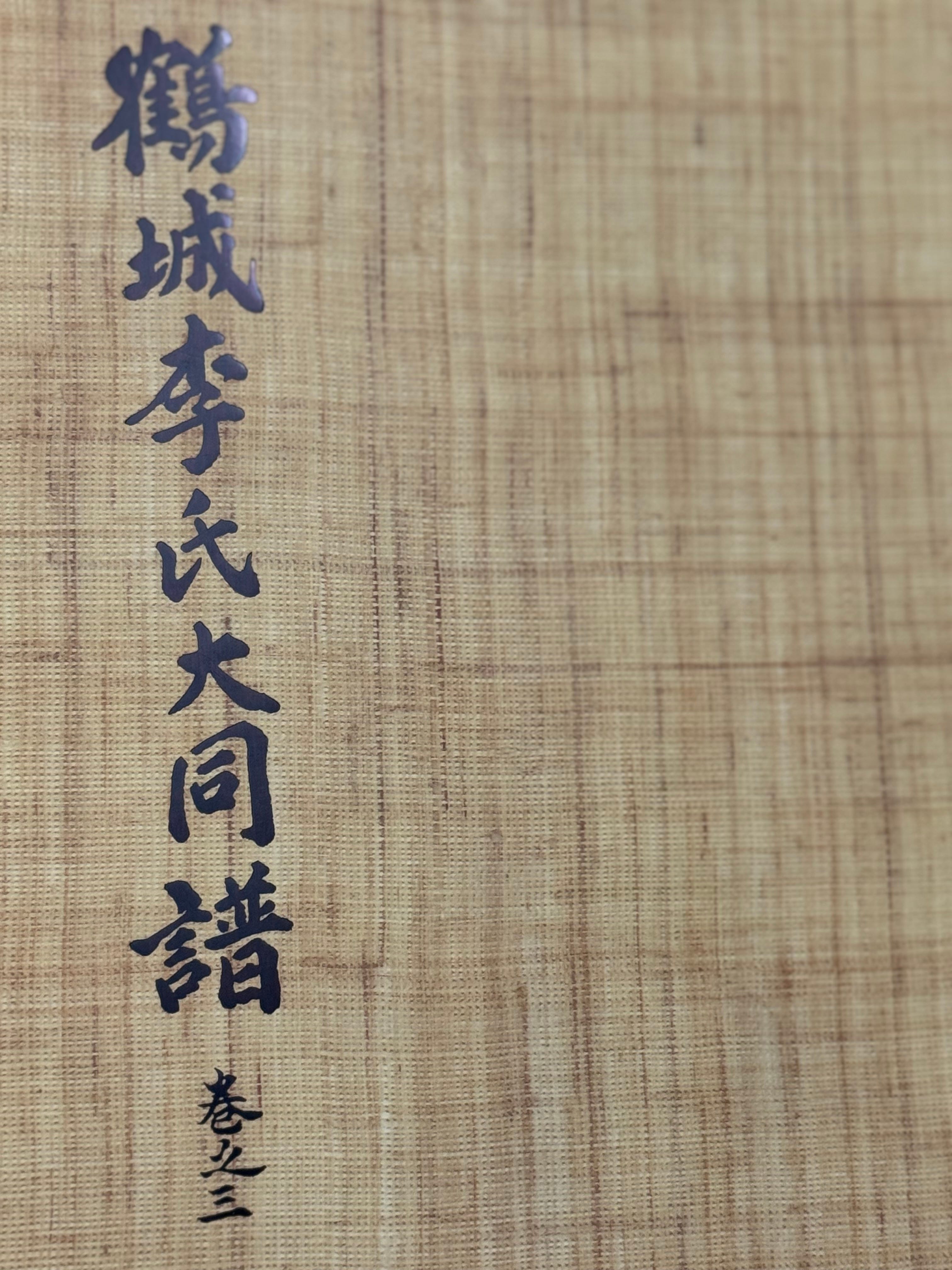
This is volume three of the family jokbo: 鶴城李氏大同譜, or “The Grand Unified Genealogy of the Hakseong Yi Clan”. My grandfather’s family is from Ulsan, which used to be called Hakseong, or literally “Crane Castle”. Therefore, his clan is the Hakseong Yi. My grandfather entered us into this and the following volume.
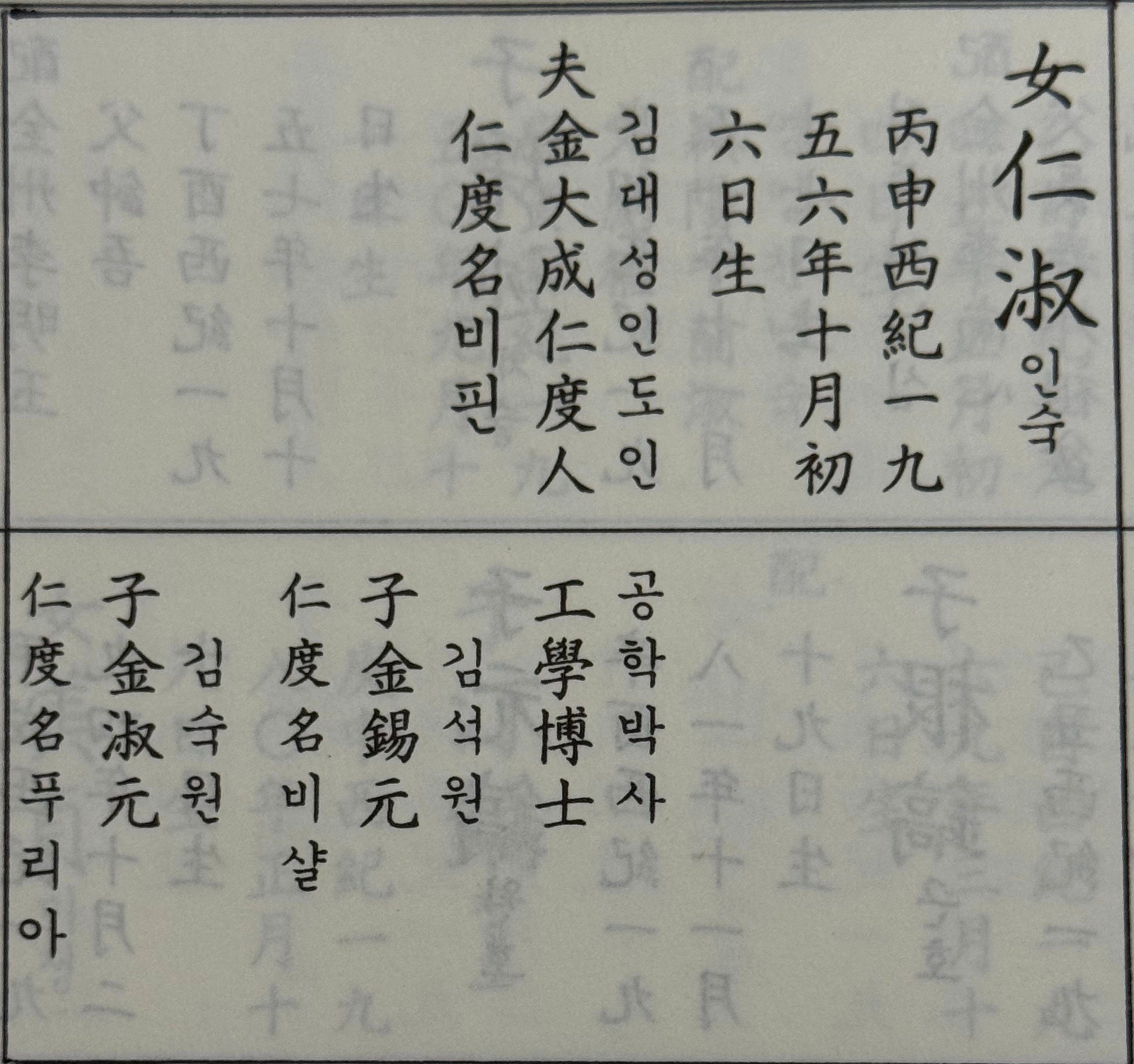
In the upper box is the entry for my mother: “Daughter. Lee In-suk,” Her name is given first in hanja and then in hangul. To the left of that is her date of birth. Then to the left of that is my father’s entry. He is written in as if he is my mother’s bride. He is given a Korean name, and in particular his surname is my grandmother’s maiden name: “Husband. Kim Dae-seong. Person from India. Indian name: Bi-pin.”
Another eccentricity is in the box below. My grandfather added credentials for my father, which structurally do not belong here. It says “doctor of engineering”. My dad does not have a Ph.D. in engineering (he has a BS in engineering and a MBA). In any case, my grandfather wanted it to be known that his son-in-law was an impressive person.
My sister and I are here too, even though we don’t belong. We are also “Kim”s under this fiction of accounting. My entry is “Child. Kim Seok-won. Indian name: Bi-sal.” My sister’s — though older, she’s after me — is: “Child. Kim Suk-won. Indian name: Pu-ri-ya.”
These oddities are the result of intercultural marriage both not being accepted in Korea, and their being disruptive to the normal bookkeeping techniques of the clan system. My grandfather was very forceful, very persuasive, and it was his will to have our existence recorded in this way.
It’s as if he’s telling me: this you shall have; my offering to you.
Crucially, a valid Homestuck Troll name
>smart fat guy at the rationality meetup
>named "great and large scholar"
nominative determinism is just real ngl