
Truth is Boring
Resisting the siren song of being interesting

Nietzsche’s universe is one of extremes folding in on themselves. In The Will to Power he says,
§55 (June 10, 1887)
Extreme positions are not succeeded by moderate ones but by extreme positions of the opposite kind. Thus the belief in the absolute immorality of nature, in aim- and meaninglessness, is the psychologically necessary affect once the belief in God and an essentially moral order becomes untenable. Nihilism appears at that point, not that the displeasure at existence has become greater than before but because one has come to mistrust any “meaning” in suffering, indeed in existence. One interpretation has collapsed; but because it was considered the interpretation it now seems as if there were no meaning at all in existence, as if everything were in vain.1
It is in this sense that Nietzsche speaks of “Christian nihilism.” Christianity resolves into nihilism because its “highest values devaluate themselves” (§2). The truth will set you free. Yeah, too free, it turns out.
What is the solution to this? Nietzsche gestures toward a third way — a “moderate” way. He continues in §55:
Who will prove to be the strongest in the course of this? The most moderate; those who do not require any extreme articles of faith; those who not only concede but love a fair amount of accidents and nonsense; those who can think of man with a considerable reduction of his value without becoming small and weak on that account: those richest in health who are equal to most misfortunes and therefore not so afraid of misfortunes — human beings who are sure of their power and represent the attained strength of humanity with conscious pride.
It is not clear what way of life is the “most moderate” in this sense, because Nietzsche never finished his project of identifying it. It’s clear from Ecce Homo that Nietzsche thought his concept of the Übermensch was widely misinterpreted and misapplied. Zarathustra is not enough (“Zarathustra himself, to be sure, is merely an old atheist: he believes neither in old nor in new gods” (§1038)). The most moderate life will be something else, something new.
By 1888, Nietzsche thought the world was fertile with dormant ideals:
§1039 (March-June 1888)
And how many new ideals are, at bottom, still possible! — Here is a little ideal I stumble upon once every five weeks on a wild and lonely walk, in an azure moment of sinful happiness. To spend one’s life amid delicate and absurd things; a stranger to reality; half an artist, half a bird and metaphysician; with no care for reality, except now and then to acknowledge it in the manner of a good dancer with the tops of one’s toes; always tickled by some sunray of happiness; exuberant and encouraged even by misery — for misery preserves the happy man; fixing a little humorous tail even to the holiest things: this, as is obvious, is the ideal of a heavy, hundredweight spirit — a spirit of gravity.
His notebooks end where he started: with Dionysus.
§1050 (March-June 1888)
The word “Dionysian” means: an urge to unity, a reaching out beyond personality, the everyday, society, reality, across the abyss of transitoriness: a passionate-painful overflowing into darker, fuller, more floating states; an ecstatic affirmation of the total character of life as that which remains the same, just as powerful, just as blissful, through all change; the great pantheistic sharing of joy and sorrow that sanctifies and calls good even the most terrible and questionable qualities of life; the eternal will to procreation, to fruitfulness, to recurrence; the feeling of the necessary unity of creation and destruction.
Nietzsche’s final offering to us, his vision of that “most moderate” life, is another stark dichotomy:
§1052 (March-June 1888)
The two types: Dionysus and the Crucified. — To determine: whether the typical religious man is a form of decadence (the great innovators are one and all morbid and epileptic); but are we not here omitting one type of religious man, the pagan? … The type of a well-constituted and ecstatically over-flowing spirit! The type of a spirit that takes into itself and redeems the contradictions and questionable aspects of existence!
…
Dionysus versus the “Crucified”: there you have the antithesis. It is not a difference in regard to their martyrdom— it is a difference in the meaning of it… The god on the cross is a curse on life, a signpost to seek redemption from life; Dionysus cut to pieces is a promise of life: it will be eternally reborn and return again from destruction.
Which way, Western man: Dionysus or crucifixion?
This final antithesis of Nietzsche’s is particularly haunting. By 1889, Nietzsche is mad and sending his “delusion letters” to his friends, signing off variously as “Dionysus” and “the crucified one.”
What to make of this? I say, dismissively, that Nietzsche was an extremophile. Like an exotic microorganism which can only survive under conditions of exquisite heat, pressure, or acidity, Nietzsche is insensate to all things you and I would recognize as “moderation.” He despised the mewling, all-too-English liberalism of “the flathead John Stuart Mill.” He proscribed, with deep hatred, the offering of liberalism as a solution to the antinomy between Christianity and nihilism.
§926 (Nov. 1887-March 1888)
Against John Stuart Mill.— I abhor his vulgarity, which says: “What is right for one is fair for another”; “what you would not, etc., do not unto others”; which wants to establish all human intercourse on the basis of mutual services, so that every action appears as a kind of payment for something done to us. The presupposition here is ignoble in the lowest sense: here an equivalence of value between my actions and yours is presupposed; here the most personal value of an action is simply annulled (that which cannot be balanced or paid in any way—).
Nietzsche’s arguments against liberalism are all pseudo-arguments. He does not show anywhere that Mill is actually wrong — he merely insists that Mill is “ignoble.” Nietzsche’s principal issue with liberalism is that it violates an aesthetic criterion: it calls on us to subordinate great passions “in service” of the weak, the herd men, the so-called “meek.” It makes us forget that “Man is beast and superbeast…” (§1027) In other words, liberalism bores Nietzsche.
The “I’m Bored” method of “refuting” liberalism is characteristic of our downwardly mobile, overproduced elites. It was a favorite trick of my Catholic and Marxist professors from undergrad. In their eyes, every intellectually serious person was called on to make a choice: Saint Paul or Nietzsche; the cross or the abyss. The thick middle is to be skipped over entirely. The liberal tradition — as traced through Hume, Spinoza, Locke, Montesquieu, Voltaire, Smith, Kant, Paine, Bentham, Fox, Wollstonecraft, Mill the father, Mill the son, Sidgwick, Keynes, Orwell, Berlin, Rawls, and Friedman — is, to the extremophiles, a house of cards / vacuous nonsense / midwitted pseudo-Christianity. Compromise, moderation, tolerance, markets, property, commerce, and polite secularism… Boring!
Nietzschean glibness lives on in many hosts to infect our political discourse. Here is Bronze Age Pervert in Bronze Age Mindset doing his best Nietzsche LARP:
63
Giving “freedom” to women—an impossibility. With the liberation of women in the 19th century, the West has given itself an infection from which it can’t recover without the most terrible convulsions and the most thorough purgative measures. What the “freedom” of women means in practice is the domination of mankind by the demagogues who can rally the lower orders of the spirit. Because there is no world in which “the women” can act as a political unit. Liberation of women means freedom and power for financiers, lawyers, purveyors of comforts in and outside government, employers who whore out your wife and daughters. It has been the greatest weakening and self-own a civilization has ever visited on itself. But in the end is this so different from democracy as such? Yes… because the “liberation” of women makes democracy into a terminal disease… one that doesn’t just end a particular government, but the civilization.
We see here the unfortunate results of poorly-digested Nietzsche. He is a malign influence, because he teaches people significantly less insightful than himself to adopt the habit of making hyperbolic assertions unburdened by the constraint of valid argument. It is a great trap, because if you attempt to rebut BAP’s paroxysmal “arguments” (perhaps by asking him to define his terms more carefully, or by noting that it’s actually not the case that all women who have jobs are whores), you’ll just be met by bored stares. “Do try and keep up, libcuck.” BAP is a man who looks at the labor market and just sees “employers who whore out your wife and daughters.” To engage with his concepts directly, on his own terms, is to be stuck in the mire of his eroto-political imagination. So either you have to ignore him, or woke-scold him (which doesn’t work anymore), engage with him by first accepting his terminology (and lose), or chip away at his hyperbole and thereby risk being “boring.”
So I say, let’s celebrate being boring.
Gen Z and Gen Alpha have a lot of fun trying on exciting new political identities. Amber A’Lee Frost wrote on the subject in 2024 for Jacobin:
Our junior accelerationist wasn’t always an adherent of what they refer to as “anti- systemic thought.” They identified as a Marxist-Leninist in 2016 — when they were eight years old. They’ve bounced around a lot, saying, “I’ve been an anarchist, fascist, communist, etc.”
…Take “J,” a twenty-two-year-old self-described “reactionary.” He was a Bernie Sanders supporter back in 2016. Or “R,” who identifies as an anarcho-communist, but was an eco-fascist in 2019 — when she was eleven.2
Frost notes the confidence with which these kids prognosticate:
And then there are the predictions, delivered with utmost confidence.
What changes do you want to see in the next ten years?
The collapse of the United States, mass awareness of the current global state, the rejection of neoliberal and Enlightenment ideals.
What changes do you want to see in the next forty years?
Collapse of the global system, return of agrarian lifestyle, a feasible solution to climate change.
I find this ironic, since the thing I associate most with Frost and her cohosts at Chapo Trap House is just how dogshit they all are at political forecasting (I haven’t checked carefully, but I believe they’ve predicted every election incorrectly since Trump 45). Online political discourse has been dominated by a host of obnoxious extremophiles: Chapo Trap House, Red Scare, Hasan Piker, Tucker Carlson, Nick Fuentes, BAP and his acolytes. The “horseshoe theory” was invented to describe this sort of creature.
However obnoxious, artless, and clueless rationalist/EA culture can be, one of its great saving graces is the emphasis on collecting “Bayes points,” and the related principle of “putting a tax on bullshit.” In other words, you do actually have to make predictions about what will happen in the world, and you are expected to eat crow when you’re wrong. By contrast, the Chapo Trap House method of handling being wrong is to go, “Oh, cool! I guess the world is even more of a hell-world than I thought!” The rationalist method runs the risk of being soul-shrinking, but it helps keep the extremophile, label-loving zoomers out, and it pulls cracked forecasters like Peter Wildeford in.
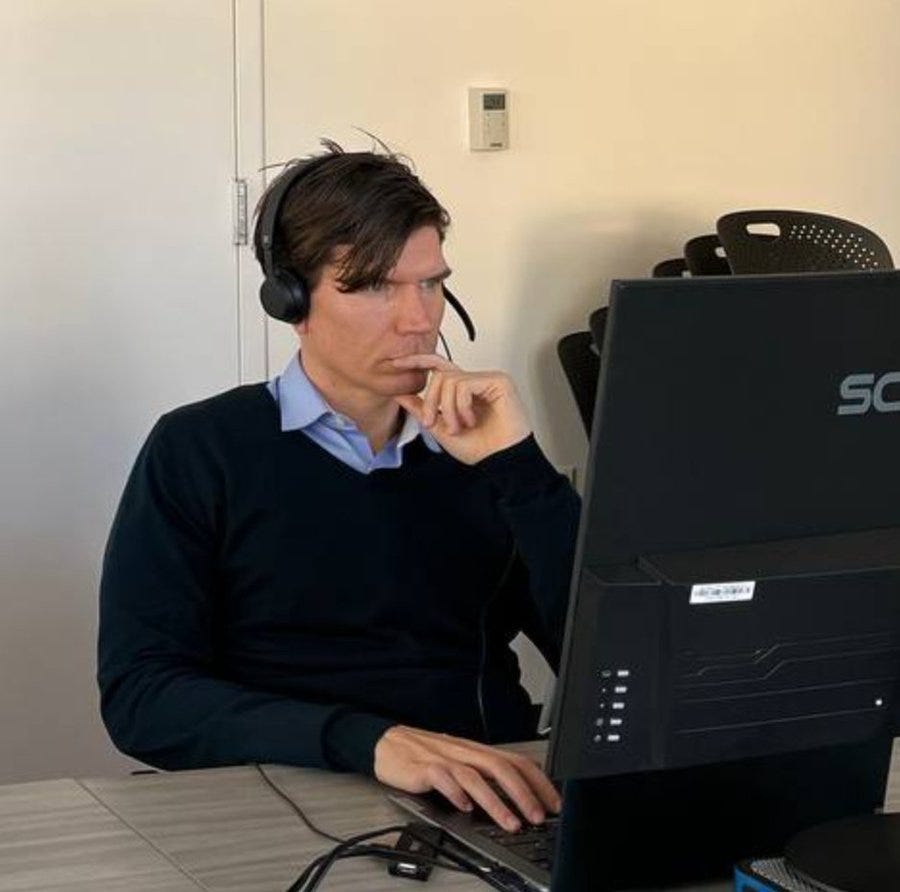
One method of combating hyperbolimania is to become extremely literally minded. Though he has calmed down considerably in recent years, the rationalist Stefan Schubert became notorious/beloved on xitter for his pedantic reply style.
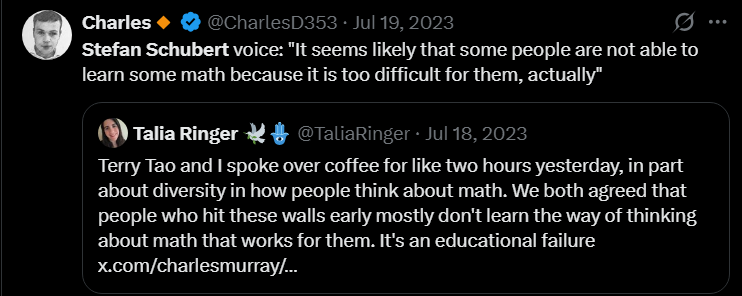
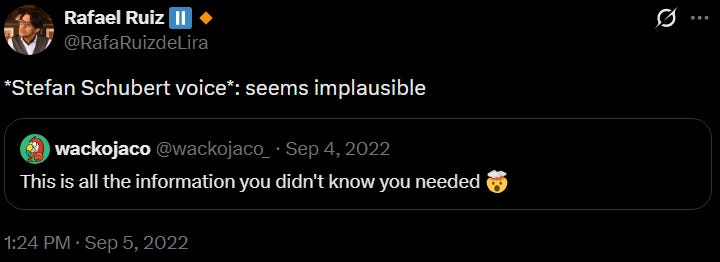
This genre of caviling is certainly fun-ruining, but it has the virtue of forcing a recalibration of the epistemic commons.
The rationalist canon of Being Boring is voluminous. Take, for instance, Scott Alexander’s “If It’s Worth Your Time To Lie, It’s Worth My Time To Correct It”:
People don’t like nitpickers. “He literally did the WELL AKTUALLY!” If you say Joe Criminal committed ten murders and five rapes, and I object that it was actually only six murders and two rapes, then why am I “defending” Joe Criminal?
Because if it’s worth your time to lie, it’s worth my time to correct it.
If one side lies to make all of their arguments sound 5% stronger, then over long enough it adds up. Unless they want to be left behind, the other side has to make all of their arguments 5% stronger too. Then there’s a new baseline - why not 10%? Why not 20%? This mechanism might sound theoretical when I describe it this way, but go to any space where corrections are discouraged, and you will see exactly this.
It is unlikely that a community which is incorrigible on small matters will prove to be corrigible on large matters. “Seeming wise” is easy when you’ve trained the people around you to feel stupid when they ask you to be precise.
Now at this point, perhaps you want to argue that Being Boring is bad because it trades increased accuracy and precision for increased triviality. I don’t think so, but it’s conceivable. Even if it does, I claim that small progress is better than no progress. Frost’s zoomers are going nowhere fast. I can’t tell you how many “college educated,” retarded zillennials I’ve met who can barely read but are nevertheless obsessed with Ted Kaczynski, Yukio Mishima, Julius Evola, Antonio Gramsci, and so on. For this type, politics tends to become the sort of elaborate mental health ritual, which, in my opinion, should really be only practiced behind closed doors.
Being Boring is a great virtue in philosophy. Sidgwick’s The Method of Ethics is possibly the greatest work of ethics ever — it’s certainly the greatest work of utilitarian philosophy. But barely anyone reads it because Sidgwick is so thorough and plodding. He goes to great lengths to avoid the obvious errors made by Mill and Kant. Even the ever-patient Derek Parfit called The Method of Ethics the “great, drab book,” and its author his “dull hero.” My undergraduate ethics course removed The Method of Ethics from the syllabus because too many students in previous iterations complained about its tedium, which left us with more time to enjoy the comparatively ribald of Utilitarianism by Mill and Groundwork of the Metaphysic of Morals by Kant. Sidgwick is so boring to read because he considers many good objections to his ideas and hedges accordingly. The result (to paraphrase Parfit) is that there may be other books in the history of ethics which contain more original ideas, but none that contain more truths.
A vote against Being Boring is a vote for believing that the world is quite simple. If hyperbole is enough to understand the world, the the world must not be a very complicated thing. Consider the following jab from ordinary language philosopher J.L. Austin:
Certainly there are a great many uses of language. It's rather a pity that people are apt to invoke a new use of language whenever they feel so inclined, to help them out of this, that, or the other well-known philosophical tangle; we need more of a framework in which to discuss these uses of language; and also I think we should not despair too easily and talk, as people are apt to do, about the infinite uses of language. Philosophers will do this when they have listed as many, let us say, as seventeen; but even if there were something like ten thousand uses of language, surely we could list them all in time. This, after all, is no larger than the number of species of beetle that entomologists have taken the pains to list.3
Politics probably isn’t simpler than entomology.
Translation by Walter Kaufmann and R.J. Hollingdale.
“Gen Z is Super Weird”, Jacobin, 2024.
J.L. Austin, “Performative Utterances”, from Philosophical Papers, 3rd edition, Clarendon Press, 1979.
It's why politicians appealing to "common sense" drives me up the wall. Part of growing up is (or should be) realizing that Life Is Complicated.
Re: BAP, there's also the option to point out that what he's saying is pathetic nonsense, that he hides behind irony because he can barely string together an actual sentence let alone an argument, etc.